Tuesday, 26 August 2014

WPP FY14 interims: Tightening cost management belies the upbeat market forecasts

WPP :   The group is tightening the screw on hiring and staff costs to absorb slowing net sales growth while maintaining the public forecasts of rising GDP and advertising expenditure into 2015. The hitherto growth engine markets of BRIC however, are looking increasingly wobbly, while the contraction in margins at the digitally heavy specialist communications division suggests pressure from rising talent costs on the groups core growth areas. For the present, markets are un-fazed as long as Draghi follows through with the QE rumours and groups such as WPP increasingly resort to share buy-backs and lower tax provisions to create the veneer of value enhancement for investors. While the current financial repression engineered by central banksters can make most share buy-ins look attractive by enhancing EPS, this is just another example of the misallocation of capital when companies are being encouraged to overpay for growth, even when it is their own.

Trading H1 FY14: FY14: Revenues +2.7% to £5,459m (WYT +1.6% to £5,413m) with net sales +4.1% organic (WYT +4.1%), -8.3% fx and +2.3% Acqs. By region, organic net sales increased by +4.3% from N.Am (RoS +30bps to 14.9%), +6.9% from UK (but with RoS -20bps to 13.7%), +0.6% from W.Europe (Ros +10bps to 9.3%) and +5.5% from RoW (but RoS -60bps to 13.1%). By category, organic revenue growth was +5.9% for Advertising & Media (margins however flat at 14.7%), +1.2% for Data Inv mgt (margins +10bpts to 10.5%), +2.7% for PR (margins +180bps to 15.0%) and +3.8% for Branding & Identity, Healthcare & Specialist Comms (margins down -100bps to 11.2% however). Net New Business was $4.089bn, which was slightly below our $4.39bn forecast.

Costs: Against constant currency revenue growth of +6.4%, constant current currency cost growth was held at +6.2%, ergo, the +30bps constant currency margin uplift reported (vs reported margins flat at 13.0%). Within this number, staff costs as a proportion of net revenues edged up from 66.5% to 66.6%, notwithstanding cuts in cash incentives (from £78m to £54m) and modest increase in like for like FTE numbers; +1.7% YoY to period end and +1.5% average for H1.

OUTLOOK FY14: Group FY14 guidance remains at >+3% for lfl net sales and +30bps (at constant fx) for EBITA margins. On a macro perspective, WPP did not re-iterate its previous (at Q1) FY14 global GDP growth estimate of +3.6% (+5.7% nominal), although it continues to forecast global advertising expenditure growth of +4.5% for 2014, rising to +5.0% in 2015. The latter year estimate, includes an improved level of expenditure across every major market with the exception of LatAm, where the drop-off in the estimated rate of growth to +8.7%, vs +10.1% for 2014, is still relatively benign. Clearly, all’s well in someone’s garden, albeit they ought to go easy on the weed!

In many ways, WPP is a microcosm of the broader market; a diminishing capacity to raise margins against a faltering top-line growth proposition and thereby having to resort to levering cheap capital to drive acquisitions and buy-backs in order to sustain the EPS growth mantra.  Perhaps, there are still some optimists out there that believe that “it’ll be better next year”, notwithstanding  this has been pushed out each year, only to see the growth forecast crumble.  But who really cares? Sovereign debt yields across southern Europe have little connection to those countries ability to pay, unless the EU really is the "transfer union" that Draghi says it's not and the Karlsruhe judgement ruled would be illegal. As long as central banks flood financial markets with liquidity and depress returns, the game is not whether WPP et al are misallocating capital by over-paying for lower growth, but whether equities as an asset class remains attractive (by default) and if WPP shares remain an efficient proxy for this.  Of course, the madness won’t last, but until currency markets restore discipline, it seems to be the only game in town.


Wednesday, 6 August 2014

The old fox learns a new trick - Murdoch walks away from Time Warner


Having seen the outrageous premium Murdoch paid for the WSJ, markets must have been salivating over how much he might now stump up for Time Warner. Surely, the $86ps ($80bn) offer was a mere opening shot and that the old boy could be bounced into perhaps three figures, or so the narrative went. Not to be lads! The 'old-boy' has done a runner and left the spivs holding their longs in TWX and without another putative bidder in sight, the bid premium could evaporate.

Perhaps this a cunning ploy to lower expectations and soften up the TWX management ahead of a future return for TWX? If it is, it would be a remarkably long term strategy for an 83 year old. Instead, one should follow the money. Having arranged a $7.5/$8bn cash release from selling Fox's European pay TV assets to BSkyB, initially to part fund the TWX offer, Murdoch is now proposing to spend the bulk of this ($6bn) on a share buy-back at Fox. If Murdoch was getting investor push-back on the prospective tidal wave of 'A' non-voting Fox shares that he would have to issue, even with the Sky cash, then a return for TWX, without the cash seems even less probable. As per my previous blogs on the subject, the Murdoch strategy is centered around retaining control while raising funds using cascading shareholdings and restricted voting shares.  Yes, he could always offer to issue voting shares, but is this really probable that he would risk his legacy to his children at this stage? No, he'd rather walk away. Perhaps an old fox can learn new tricks after all!


A reminder on TWX from the WYT Growth rater service

BMW Q2 results: three quarters of unit sales growth were from China!

What was that supposed Chinese curse - "May your wishes come true"?

Well for foreign auto manufacturers dreaming of rising Chinese sales to offset withering Latin American demand and possible interest rate rises this may not have seemed much like a curse. Without China, BMW's Q2 unit deliveries would have been up by a meagre +1.4%, notwithstanding the 16 model launches and previous year's heavy investments. The silver lining however has a black cloud. I'm not just referring to the increased reliance on a possibly slowing market, but the changing relationship between buyer and seller that inevitably arises as markets mature. Welcome to the world of the commercial shake-down. The US has been at it for a long time and with some spectacular foreign scalps taken recently such as the $9bn 'settlement' from BNP.  The Chinese however, seem to be learning fast as seen by some recent headlines from their "National Development and Reform Commission (NDRC). Having worked over a few big names in other sectors, the NDRC are now taking some pot-shots at the Auto segment with their anti-monopoly laws and are threatening to punish Audi and Chrysler.

Will it change the game? No, Auto manufacturers can't afford to be out of this market, but it will raise the cost of doing business there.


Comment on BMW from the WYT growth rater service:-

BMW: Market leader in the premium car segment with higher NPD expenditure sustaining record unit sales, albeit with a lagged delivery into margins. With 16 new models and model revisions being launched into this year, 2014 was always going to be a strong performer, particularly for an auto manufacturer in the premium segment, where aspirational Chinese accounted for 75% of Q2’s +27k/+5.3% increased unit sales.  As LatAm markets wither and Russian sanctions ratchet up however, this dependency on the Chinese buyer may not be entirely favourable. Not merely as Chinese growth levels off, but as Chinese authorities learn how to leverage market access into control and fees. If the US can charge/shake-down BNP for $9bn to retain access to its markets, then what price is access to Chinese consumers worth – see recent move against Audi (link below).

http://www.reuters.com/article/2014/08/06/us-china-autos-antitrust-investigation-idUSKBN0G604J20140806

Trading – Q2 FY14: Revenues +1.8%/+€353m (negative fx impact not disclosed) with EBIT +26%/+€537m on unit deliveries up +5.3%/+27k to 533k units and FTE’s +5.3% to 112.5k. Within these figures, Auto revenues advance by +1.7%/+€303m with Auto EBIT recovering by +23%/+€ 406m to €2,161m after last year declines in higher R&D charges (not disclosed in Q2).  By brand, BMW unit sales increased by 8.3% (to 458k units) with mini -10.4% (to 74k units) and Rolls Royce +28.6% (to 1.1k units). Motorcycles raised EBIT by +19.6%/+€9m to €55m on revenues +11.2%/+€53m while Financial services EBIT fell -1.9%/-€9m to €459m with group PBT rising +30.9% (to €2,660m) and EPS by +27.5% to €2.69.

OUTLOOK FY14:  Sharp rise in global sales volumes expected (to >2m units) benefitting from 16 new models and model revisions.  Auto EBIT margins are expected to be in 8-10% range (9.4% in FY13) and profits expected also to rise “significantly” albeit with the pace of EBIT growth expected to be “affected by high levels of expenditure for new technologies and by rising personnel expenses”.


Saturday, 26 July 2014

Facebook - Q2 FY14: Squeezing out the returns, but DAU growth slowing


Unparalleled qualitative information on consumers and unmatched reach makes Facebook a must have for both advertisers and NSA alike. For the moment, the group is managing the migration to lower yield mobile and overseas users while sustaining overall yield growth of +41% YoY and +14% QoQ and somewhat surprisingly, an average yield increase on non-mobile DAU that is actually greater than that for mobile! Having convinced the advertisers to spend, Facebook’s low direct cost component is enabling the marginal revenues to drop down substantially through to margins and even more impressively to cash/marketable securities. Indeed, the ability in H1 to increase revenues by almost $1.1bn with accounts receivable expanding by just $81m is truly impressive.   Social media users however are fickle and today’s cool site may not be so appealing should the owners appear to sell-out to commercial and government interests.  Yes, reach is still growing, but at +3% QoQ, not by that much and any reversal could quite quickly see remedial costs thrown at the hole and reverse some of today’s spectacular performances.  


Trading Q2 FY14: Revenues +61%/+$1.097bn to $2.91bn (vs Q1 +72%/+$1.044bn), costs +22%/+$269m to $1.52bn (vs Q1 +32%/+$342m to $1.43bn), EBIT +147%/+$828m to $1.39bn (vs Q1 +188%/+$702m to $1.075bn) and margins +17pts to 48% (vs Q1 +17pts to 43%). Within revenues, advertising (91% of revenues) advanced+67% to $2.68bn (vs Q1 +82% to $2.27bn), including mobile (62% of advertising vs 59% in Q1).  Daily active users (DAUs) meanwhile, increased by +19% YoY to 829m (vs Q1 +21% YoY to 802m), including mobile at +39% to 654m (vs Q1 +43% to 609m).  After -$469m of CapExp (16.1% of revenues (vs Q1 -$363m/14.5%), Q1 FCF was $872m (vs Q1 $922m) while cash and marketable securities ended the period up +$1.32bn to $13.954bn (vs end Q1 of  $12.63bn), albeit not reflected in the P&L with a net interest EXPENSE reported of -$4m (vs Q1 of -$20m)!


Friday, 25 July 2014

BSkyB & the rising cost of growth


BSkyB:  OK, so what’s the narrative to be?  21st Century Fox (Murdoch) parks some low yielding European payTV assets into a 39% owned subsidiary to raise at least £4.6bn of cash to help fund its (Murdoch’s) $80m Time Warner bid? As long as the market thinks that he will be back for the lot at a later point, with another full bid for BSkyB, once the phone hacking ruckus has died down, then he gets the cash, keeps control and supports the shares; which could always be re-hypothecated for some more funding. 

What about the core business? Last year’s stalled profits can in part be explained by the heavy step up costs for the new Premier League contract and bulls can point to the still healthy advance in revenues of +7% and the prospective rebound in profitability in the coming  year as programming costs stabilise.  The uplift from the revised Premier League contract however was a symptom of the changing distribution landscape and was not the only source of cost inflation to the group. To support all those new services came at a price, with Direct Network costs (+15%), Transmission & Technology (+11%) and Depreciation (+12%) all running well ahead of the +7% revenue growth.  If the above is the problem then, is the decision to buy Sky Italia and at least 57.4% of Sky Deutschland the solution?

Both Sky Deutschland and Sky Italia could be said to offer potential, but this could also be said of them many times over the past decade, while neither of them are particularly cheap on their current trading trajectories. Sky-D subscriber numbers and revenues have been flat-lining for years while the purchase price of €6.75ps values these subscribers  within 10% of BSkyB's on a per subscriber basis, yet with under half the revenue per subscriber generated. For Sky Italia, the growth record is better and the take-out price less onerous, although still struggling to generate much of a return.  Even with the £200m pa of projected savings by end FY17, these would represent less than 1.5% of combined sales and less than an additional 3pps return on the combined gross purchase price. With limited scope for joint rights purchase efficiencies or revenue synergies it seems investors will have to make a leap of faith here.   Having already had access to the best pay TV managers in town (including from BSkyB), it is also unclear what special sauce BSkyB will bring re-invigorate these two assets.

Trading – FY14: Revenues YoY +7% including retail subscriptions +5.1% (o/w ARPU +1.2%/+£7 and  TV subs +2.5%), Wholesale subscriptions +6.6%, Advertising +7.3%, Installation & Hardware -2.3% and Other +7.8% (incl Sky Bet at +18%).  Total paid-for subscriptions increased by +9.9% YoY to 34.775m, including TV at +264k/+2.5% YoY (o/w HD +456k YoY) and Broadband at +341k/+7.0% YoY. Q4 FY14 churn rates edged down slightly (by 20bps QoQ & YoY) to a still modest 10.9% while paid-for products per customer increased to 3.0 (vs 2.8) and with Triple-play now representing 37% of the retail subscription base (flat QoQ and +2pts YoY). FY14 adj EBITDA meanwhile declined by -£25m/-1% to £1,667m; a function of supporting new service introductions (SkyGo, Now etc) as well as higher programming costs (+7%/+£175m), including +£217m YoY increase from the step-up from the new Premier League 3 year contract. Including the benefit from a reduction in share base, the YoY decline in adj EPS was held at the previous year’s 60.0p while the FY 14 DPS was raised by +7% to 32.0p.

The ‘deal’. Excluding associated loan stock buyouts, BSkyB’s  proposed purchase commitments are between £4.97bn and £7.1bn, dependent on the proportion of Sky Deutschland that is tendered; from Fox’s 57.4% to a full 100% that is also being tendered for under German listing rules. To fund this, BSkyB is raising approx. £1.37bn via a placing of 156.1m new BSkyB ordinary shares (9.99% of the enlarged issued capital), with £382m funded from selling Fox BSkyB’s 21% stake in National Geographic and with the remainder funded by debt (possibly up to a max 2.9x debt/EBITDA). To maintain its 39.1% holding in BSkyB meanwhile, Fox will be taking up its entitlement. From Fox’s perspective, the disposal is worth approx. £5.35bn gross (£2.9bn for its 57.4% of Sky Deutschland and £2.45bn for the 100% of Sky Italia. As £382m will be part paid for by BSkyB’s 21% stake in National Geographic and Fox’s share of the placing will cost it around £730m, the net cash receipt for Fox should be approx. £4.24bn.


Pearson H1 FY14 results - cost savings promised, but no growth committment yet


Markets took a little time to appreciate the current cyclical and structural squeeze on profitability, but eventually got the message.  So far, that message is pain today as the group invests to extend is leadership in digital learning through a protracted cyclical downswing in its main markets followed by jam tomorrow as these measures yield returns and their accompanying costs drop away as early as FY15. This time-scale, may or may not be realistic, but having been strung again by missed expectations, markets may first wish to see some tangible evidence of restored organic revenue growth before wishing to reach out and discount the ‘recovery’ in FY15 and beyond. As usual, the lightly weighted H1 provides little hard evidence on progress, with this year’s results incurring a further £14m of restructuring charges, but offset by a slightly more favourable phasing of US educational sales than usual in the period.  Having re-arranged the reporting structure into the somewhat opaque new divisions (including “Growth” and “Core”) meanwhile, transparency into the businesses is not improved (FT is now ‘lost’ and is Brazil really “Growth”?), investors are therefore increasingly dependent on the narrative from management as to whether the current investment will actually deliver. For the moment, the focus seems to be on the cost fall-away into 2015 rather than any particular revenue growth commitment.

Trading H1 FY14: Revenues of £2,047m (+0% organic,+2% Acq,-9% fx) with EBITA of £75m (-40%/-£50m organic, +4% Acq, -9% fx) which was after a -£14m increase in restructuring charges (from -£29m to -£43m); vs WYT estimate of £73m of EBITA on a similar charge and organic revenue growth number.  By division, a heavier phasing of sales into H1 assisted North America to a +2% organic revenue rise with EBITA +24% to £36m notwithstanding a -28% fx drag. The new “Core” division however saw organic sales drop by -8% (weak UK curriculum and phasing) and EBITA by -76% (to  £13m). The new “Growth” segment (emerging market education and FT?) meanwhile is still living up to its moniker and delivered a +4% reported sales increase and +7% organic, albeit with reported EBITA halving from £12m to only £6m.

OUTLOOK:  FY14 expected to remain a transition year with continued cyclical headwinds from US & UK educational markets, but with lower restructuring charges, albeit partially absorbed by additional NPD expenditure and the adverse impact of fx movements.  On a net basis, the group is re-iterating its FY14 adj EPS forecast range of between 62-67p on the 28 Feb fx rate ($1.666 vs the current $1.697).  

Note: Net restructuring charges/benefits for FY14 are forecast at +£136m (v -£135m in FY13) including +£126m from lower restructuring charges, +£60m of incremental cost savings, but a -£50m increase in NPD.  For FY15, the group is targeting a further +£95m of net benefits to drop through to EBITA from +£50m reduced restructuring plus +£45m of additional cost savings, but no additional NPD.   


Sunday, 20 July 2014

Murdoch and the art of using other people's money

So you've seen the headlines. First Fox's proposals to consolidate its interests in Sky Italia and Sky Deutschland into BSkyB, described by many as a "tidying up" exercise. Now we are treated to something more substantial to explain the earlier moves; an $80bn (c.$86 ps) plus offer for Time Warner.  The newswires are of course buzzing with analysis of the commercial logic and potential regulatory pitfalls of the proposed deal, along with the inevitable speculation about how much more can be squeezed out of Fox. There is another issue at play here however, that investors need to heed; the growing disconnect between voting control and equity risk.

There is nothing new about cascading shareholding and voting structures being used to exert control over companies.  While these companies perform to their potential, then shareholders usually turn a blind eye to the asymmetric relationship between risk and control. An enlightened despot however may be followed by a less capable one and that unfortunately is when the disenfranchised sheep learn about the equity risk premium.

21st Century Fox has two classes of equity, 2.23bn of the 'A' non-voting ordinaries with a market value of approximately $73.6bn and 0.712bn of the voting 'B' shares currently worth around $24bn.  The Murdoch family controls this c.$98bn of market value with a 39.4% stake of the 'B' voters; in other  words, with under 10% of the risk equity (39.4% x $24bn =$9.5 /$98bn = 9.6%).

This disconnect between risk and control however is not just limited to this top layer of ownership, but cascades down via a series of subsidiary layers which effectively leverage this disparity further with each step down. Take for example Fox's European broadcast interests; 100% of Sky Italia, 57% of Sky Deutschland and 39% of BSkyB. The Murdoch family control all of these assets, although with an effective equity risk exposure of only 9.4% for Sky Italia, 5.4% for Sky Deutschland and 3.7% for BSkyB. But the fun doesn't stop here though. Earlier this year, Fox proposed to fold its stakes in Sky Deutschland and Sky Italia into BSkyB - the purported 'tidying up' exercise. Regardless of the inherent risk that Fox would extract a 'control' premium from BSkyB for these assets, such a move would have further transferred equity risk on these assets to external investors while maintaining control by Murdoch. The effective share of Murdoch's equity risk for his stakes in both Sky Italia and Sky Deutscheland would have dropped to a mere 1.4%. For Fox, this deal would also have released around $11bn of cash with no effective reduction in control on these assets. Even were Fox to consolidate its share of BSkyB's increased debt, this would still add almost $7bn to Fox's funding headroom.

So back again to this Time Warner offer. 40% is in cash with the remainder in shares; not the 'B' voters however, but the 'A' non-voters. If Murdoch senior aims to leave management control to Murdoch juniors, he cannot afford to relinquish control at the top of this chain otherwise it will be game over. If this is his wish, and there is nothing to suggest otherwise, then speculation that he will sweeten the pot for Time Warner with an issue of voting shares seems wide of the mark.

Wednesday, 21 May 2014

Cheap new cash = property boom. Nothing has changed in 2,000 years!

He “made money so plentiful, that interest fell and the price of land rose considerably, And afterwards, as often as large sums of money came into his possession by means of confiscations, he would lend it free of interest, for a fixed term, to such as could give security for the double of what was borrowed.”

One may be forgiven for thinking the writer is referring to the current monetary policies being pursued across the globe. The author however was Suetonius and he was referring to Augustus over two thousand years ago. The similarities of course is that if you pump new cash into an economy and lend it at virtually no cost, it will inevitably be invested in other asset classes and drive up prices. It was blindingly obvious two millennia ago as it should be today.

There are however a number of worrying differences. Fractional banking and fiat currencies hadn’t yet been developed and the Romans at that stage didn’t need to resort to debasement, at least of their currency. After 31 BC, Augustus (albeit still just Octavian [sic] then) was busy plundering Egypt’s treasures and shipping it back to Rome and it was this that was being lent out to his cronies to make a fast aureus in property or buy their way into the senate – well okay, that part hasn’t changed much!  The main difference however is that the Roman property boom at the end of the first century BC was based on the injection of real treasure into the economy.  This time, new credit is being created to service previous credit as a means of keeping the previous bubble inflated while they try and ship the worst of their bad debts off their books and for Government’s to pretend that their budget deficits are not facing a demographic time-bomb. So will this new credit that is being so liberally extended across virtually every major trading zone ever get repaid? At least Octavian’s insistence of a 50% equity cushion meant that he at least stood a good chance of getting repaid.

Friday, 9 May 2014

What, no PubicOm?


Shock, horror. "Publicis and Omnicom agree to terminate proposed merger of equals"

10 months ago when Publicis and Omnicom announced their intention to merge I wrote two articles on this blog. The first was titled 'Omnicom & Publicis - a marriage not made in heaven' and was an initial response to the press leaks of the merger and it queried the limited business logic of the proposed combination (modest or revenue cost synergies and a risk of substantial revenue leakage), the incompatible acquisition strategies as well as the "inevitable cultural clash".  This was followed up the next day as the companies confirmed much of the details with another article 'Publicis Omnicom Groupe - financials less exciting than the impending management soap opera'. In it, I re-iterated my previous sentiments, in particular in response to the suggested dual management structure, to be managed out of both New York and Paris, but with a head office in the Netherlands. Referring to the similarly misconceived strategy initially created to facilitate the merger of Reed International and Elsevier a decade earlier, which ended disaster and had to be dropped, I wrote "something that will inevitably happen here if adopted unless it is to become a mongrel".

So, 10 months later after increasing reports of squabbles between the parties on the share out of the top jobs, we get the obliquely worded statement that it is all off and by mutual consent. For two supposedly savvy titans in the marketing services industry with their cohorts of advisors one might well ask how this train wreck was permitted to proceed for so long without having first confronted such basic management and strategic issues first; particularly when the industrial logic was already looking fairly tenuous to begin with. Also, did anyone not notice a certain sang froid between the "Freedom fries" and the "Cheese eating surrender monkeys" including Coca-Cola's failed approach for Danone and more recently GE's approach for Alstom?

What now? Both companies and advisors will now go into damage limitation mode and spin away that they will do almost as well apart as they would have been together. A number of issues however will need to be addressed.  1) Management succession, particularly at Publicis to replace the soon to be retiring CEO, Maurice Levy.  2) Digital services, particularly for Omnicom which has avoided being sucked into the digital buying boom, but now without Publicis's portfolio of recently acquired digital assets to leverage from it may need to re-think its acquisition strategy in this respect. On a more general level however, the financial markets will try and gauge a further two points. First, how much of the proposed cost synergies (c. +200bps to margins) from the proposed merger that were already being anticipated by the merger should now be backed out (ie how much of the 10-15% merger premium on the shares ought to removed), or will the respective management try and compensate by enacting tighter cost measure independently. Secondly, to what extent does this merger failure raise or lower the expectations for other corporate consolidations in the market? Will it drive Publicis into the arms of IPG or has the experience put it off the whole dating game for the moment. While no doubt there will be plenty of market punters touting the IPG story again, my personal take is that this will take some of the speculative heat out of the sector for the time being. 


Wednesday, 30 October 2013

Welcome to the UK recovery!

Still faced with a structural deleveraging in personal and public debt, the policy response by those who ought to know better remains the same – juice the system and hope growth miraculously appears.  That’s right, the same strategy as adopted for Greece, Portugal, Spain, France etc, etc, & etc. 

After the >+10% MoM rise in asking prices for London homes published by Rightmove, another vested interest group, the Council for Mortgage Lenders issued a press release highlighting the increase in mortgage approvals from 64k in August to 67k in September. Bank of England data released on 18 October was already showing a 25% YoY increase in UK property backed loans for August.   Consumer credit meanwhile is not being restricted to just property backed loans.  The Arch-Bishop of Canterbury may not approve, but net unsecured debt is also up, rising by £411m MoM in September; a +4.4% YoY increase.   As good Keynsians know well, rising credit equates to increased consumption and therefore growth so all this must be good for the recovery!
Encouraging consumers to leverage into property ahead of a possible rise in interest rates or take on more Wonga type debt however, seems an odd basis for celebration if not supported by real income growth.  Consumer credit may be expanding to fund current consumption, but real income growth will need to be supported by re-investment by industry.  While consumers were loading up with £411m of additional unsecured credit in September, lending to SMEs fell by an almost comparable amount of -£383m.  You can’t blame the banks as they are merely responding to the environment that Governments and regulators have created, just as we saw with most other financial cock-ups from the Savings and Loans debacle to the sub-prime crash.  When you can make a property loan with a Government backed guarantee or a pay-day loan with an APR of >1000%, then why should a bank go at risk to lend to some SME with no realisable assets and a business plan you don’t understand?  

Property back loans continue to rise: +67k in Sept vs +64k in Aug


Consumer credit increases +£411m in September


SME lending however down £383m in September


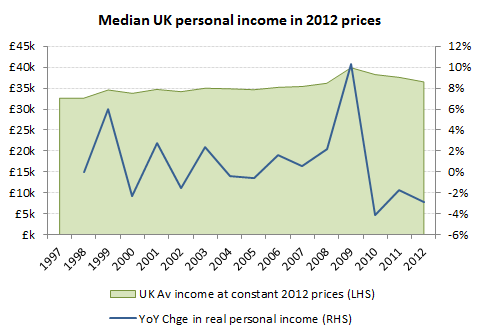
Not exactly positive for real personal income growth!


Consumers therefore continuing to buy more stuff with cheap credit, but particularly vulnerable to any increase in debt servicing costs while real income growth and SME investment remain constrained.