UK supermarkets are a bit like the beer they used to sell; bland and
too many of them. Tesco however is working on that one as it culls its
less profitable sites and brands (including the #4 UK brand, Carlsberg)
to restore its growth and margin metrics, even it means from a lower
base of revenues and margins. Tesco's interim results released yesterday
therefore reflect this dynamic of what was a slight deterioration in
actual UK sales growth in Q2 to -0.9% YoY vs the -0.4% posted for Q1,
but having eliminated the weaker perfomers from the average meant that
the Q2 like for like sales in the UK surged from -1.3% to -1.0%, to take
the first half average to -1.1%. While a considerable improvement on
the prior trajectory, it was not without cost, with UK & RoI
operating profits collapsing by 69% (-£377m) to only £166m and a margin
down -200bps to only 0.9%. Given the profit decline of -£377m
substantially exceeded the underlying revenue decline of -£226m and that
the group had taken around £6.8bn of provisions last year to help pad
out the bottom line this is a pretty remarkable performance. Either
management is keeping its powder dry for the great cost led margin
rebound just ahead of their option vestings in 2-3 year time or the
apparent stabilisation in top line sales was expensively purchased out
of gross margins. While this may keep some pressure off the new
management, this is no substitute for a sustainable recovery,
particularly when the share price is still reaching out to well above
even where consensus forecasts are anticipating in FY17.
With
underlying organic sales growth still negative and the shares trading
on a current year prospective operating FCF yield of possibly under 3%
markets are clearly reaching out into a future where a restoration in
operating margins and possibly also near market average growth rating
may also be in prospect. If one were to take a fairy upbeat assessment
that the group ought to be able to justify an underlying growth rating
of around +4% pa (and circa 7% Op FCF yield), then we estimate that the
group needs to convince markets of its capacity to restore operating
margins to near peak levels of around 5%, or to over +50% above where
consensus estimates are currently for FY17. We may be through the
trough, but is the pace of improvement currently being delivered by
either Tesco or its competitors really enough to take us to these
valuation highlands within a credible investment horizon? At this stage,
the group needs to a capacity for some serious over-delivery rather
than merely tracking existing expectations.
Showing posts with label recovery. Show all posts
Wednesday, 7 October 2015
Wednesday, 30 October 2013
Welcome to the UK recovery!
Still faced with a structural deleveraging in personal and
public debt, the policy response by those who ought to know better remains the
same – juice the system and hope growth miraculously appears. That’s right, the same strategy as adopted
for Greece, Portugal, Spain, France etc, etc, & etc.
After the >+10% MoM rise in asking prices for London homes
published by Rightmove, another vested interest group, the Council for Mortgage
Lenders issued a press release highlighting the increase in mortgage approvals from
64k in August to 67k in September. Bank of England data released on 18 October
was already showing a 25% YoY increase in UK property backed loans for
August. Consumer credit meanwhile is
not being restricted to just property backed loans. The Arch-Bishop of Canterbury may not approve,
but net unsecured debt is also up, rising by £411m MoM in September; a +4.4%
YoY increase. As good Keynsians know well, rising credit
equates to increased consumption and therefore growth so all this must be good
for the recovery!
Encouraging consumers to leverage into property ahead of a
possible rise in interest rates or take on more Wonga type debt however, seems
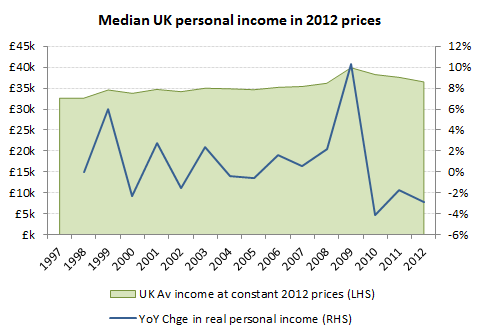
an odd basis for celebration if not supported by real income growth. Consumer credit may be expanding to fund
current consumption, but real income growth will need to be supported by
re-investment by industry. While
consumers were loading up with £411m of additional unsecured credit in
September, lending to SMEs fell by an almost comparable amount of -£383m. You can’t blame the banks as they are merely
responding to the environment that Governments and regulators have created,
just as we saw with most other financial cock-ups from the Savings and Loans
debacle to the sub-prime crash. When you
can make a property loan with a Government backed guarantee or a pay-day loan
with an APR of >1000%, then why should a bank go at risk to lend to some SME
with no realisable assets and a business plan you don’t understand?
Property back loans continue to rise: +67k in Sept vs +64k
in Aug
Consumer credit increases +£411m in September
SME lending however down £383m in September
Not exactly positive for real personal income growth!
Consumers therefore continuing to buy more stuff with cheap
credit, but particularly vulnerable to any increase in debt servicing costs
while real income growth and SME investment remain constrained.
Subscribe to:
Posts (Atom)