He “made money so plentiful, that interest fell and the price of land
rose considerably, And afterwards, as often as large sums of money came
into his possession by means of confiscations, he would lend it free of
interest, for a fixed term, to such as could give security for the
double of what was borrowed.”
One may be forgiven for thinking the writer is referring to the
current monetary policies being pursued across the globe. The author
however was Suetonius and he was referring to Augustus over two thousand
years ago. The similarities of course is that if you pump new cash into
an economy and lend it at virtually no cost, it will inevitably be
invested in other asset classes and drive up prices. It was blindingly
obvious two millennia ago as it should be today.
There are however a number of worrying differences. Fractional
banking and fiat currencies hadn’t yet been developed and the Romans at
that stage didn’t need to resort to debasement, at least of their
currency. After 31 BC, Augustus (albeit still just Octavian [sic] then)
was busy plundering Egypt’s treasures and shipping it back to Rome and
it was this that was being lent out to his cronies to make a fast aureus
in property or buy their way into the senate – well okay, that part
hasn’t changed much! The main difference however is that the Roman
property boom at the end of the first century BC was based on the
injection of real treasure into the economy. This time, new credit is
being created to service previous credit as a means of keeping the
previous bubble inflated while they try and ship the worst of their bad
debts off their books and for Government’s to pretend that their budget
deficits are not facing a demographic time-bomb. So will this new credit
that is being so liberally extended across virtually every major
trading zone ever get repaid? At least Octavian’s insistence of a 50%
equity cushion meant that he at least stood a good chance of getting
repaid.
Wednesday, 21 May 2014

Friday, 9 May 2014
What, no PubicOm?
Shock, horror. "Publicis and Omnicom agree to terminate proposed merger of equals"
10 months ago when Publicis and Omnicom announced their intention to merge I wrote two articles on this blog. The first was titled 'Omnicom & Publicis - a marriage not made in heaven' and was an initial response to the press leaks of the merger and it queried the limited business logic of the proposed combination (modest or revenue cost synergies and a risk of substantial revenue leakage), the incompatible acquisition strategies as well as the "inevitable cultural clash". This was followed up the next day as the companies confirmed much of the details with another article 'Publicis Omnicom Groupe - financials less exciting than the impending management soap opera'. In it, I re-iterated my previous sentiments, in particular in response to the suggested dual management structure, to be managed out of both New York and Paris, but with a head office in the Netherlands. Referring to the similarly misconceived strategy initially created to facilitate the merger of Reed International and Elsevier a decade earlier, which ended disaster and had to be dropped, I wrote "something that will inevitably happen here if adopted unless it is to become a mongrel".
So, 10 months later after increasing reports of squabbles between the parties on the share out of the top jobs, we get the obliquely worded statement that it is all off and by mutual consent. For two supposedly savvy titans in the marketing services industry with their cohorts of advisors one might well ask how this train wreck was permitted to proceed for so long without having first confronted such basic management and strategic issues first; particularly when the industrial logic was already looking fairly tenuous to begin with. Also, did anyone not notice a certain sang froid between the "Freedom fries" and the "Cheese eating surrender monkeys" including Coca-Cola's failed approach for Danone and more recently GE's approach for Alstom?
What now? Both companies and advisors will now go into damage limitation mode and spin away that they will do almost as well apart as they would have been together. A number of issues however will need to be addressed. 1) Management succession, particularly at Publicis to replace the soon to be retiring CEO, Maurice Levy. 2) Digital services, particularly for Omnicom which has avoided being sucked into the digital buying boom, but now without Publicis's portfolio of recently acquired digital assets to leverage from it may need to re-think its acquisition strategy in this respect. On a more general level however, the financial markets will try and gauge a further two points. First, how much of the proposed cost synergies (c. +200bps to margins) from the proposed merger that were already being anticipated by the merger should now be backed out (ie how much of the 10-15% merger premium on the shares ought to removed), or will the respective management try and compensate by enacting tighter cost measure independently. Secondly, to what extent does this merger failure raise or lower the expectations for other corporate consolidations in the market? Will it drive Publicis into the arms of IPG or has the experience put it off the whole dating game for the moment. While no doubt there will be plenty of market punters touting the IPG story again, my personal take is that this will take some of the speculative heat out of the sector for the time being.
Wednesday, 30 October 2013
Welcome to the UK recovery!
Still faced with a structural deleveraging in personal and
public debt, the policy response by those who ought to know better remains the
same – juice the system and hope growth miraculously appears. That’s right, the same strategy as adopted
for Greece, Portugal, Spain, France etc, etc, & etc.
After the >+10% MoM rise in asking prices for London homes
published by Rightmove, another vested interest group, the Council for Mortgage
Lenders issued a press release highlighting the increase in mortgage approvals from
64k in August to 67k in September. Bank of England data released on 18 October
was already showing a 25% YoY increase in UK property backed loans for
August. Consumer credit meanwhile is
not being restricted to just property backed loans. The Arch-Bishop of Canterbury may not approve,
but net unsecured debt is also up, rising by £411m MoM in September; a +4.4%
YoY increase. As good Keynsians know well, rising credit
equates to increased consumption and therefore growth so all this must be good
for the recovery!
Encouraging consumers to leverage into property ahead of a
possible rise in interest rates or take on more Wonga type debt however, seems
an odd basis for celebration if not supported by real income growth. Consumer credit may be expanding to fund
current consumption, but real income growth will need to be supported by
re-investment by industry. While
consumers were loading up with £411m of additional unsecured credit in
September, lending to SMEs fell by an almost comparable amount of -£383m. You can’t blame the banks as they are merely
responding to the environment that Governments and regulators have created,
just as we saw with most other financial cock-ups from the Savings and Loans
debacle to the sub-prime crash. When you
can make a property loan with a Government backed guarantee or a pay-day loan
with an APR of >1000%, then why should a bank go at risk to lend to some SME
with no realisable assets and a business plan you don’t understand?
Property back loans continue to rise: +67k in Sept vs +64k
in Aug

Consumer credit increases +£411m in September

SME lending however down £383m in September

Not exactly positive for real personal income growth!
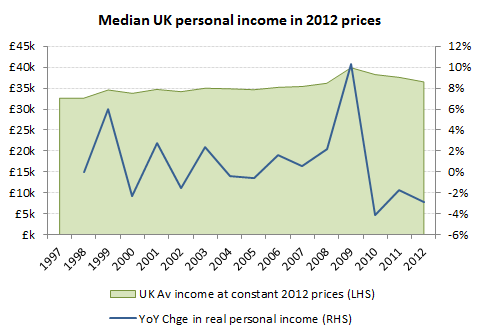
Consumers therefore continuing to buy more stuff with cheap
credit, but particularly vulnerable to any increase in debt servicing costs
while real income growth and SME investment remain constrained.
Sunday, 27 October 2013
Will you be see the collapse in the property market coming?
Will you be see the collapse in the property market coming?
There is an entire industry of vested interests out there to ensure that you
don’t. You have a Government whose declared purpose is to juice demand and
support funding with its various schemes to encourage the consumer to put
themselves further into hock at current inflated levels. You have the entire
financial services industry also pushing the same story along with its cheerleader,
the central banks. We are confidently told that the economy is now recovering
and as an apparent confirmation of this, Rightmove has reported a month on
month increase in central London asking prices for properties of over 10%!
As with any good magic trick however, the audience needs to
be distracted from the real slight of hand. Behind the headlines of meaningless asking
price expectations, a number of
long-standing property investors, both UK blue chip as well as overseas
(including Russian and Saudi) have been quietly divesting some of their trophy
property assets. Rental prices meanwhile are also beginning to crack (check out
Zoopla), initially in the financial services exposed areas such as Canary
Wharf, but now more recently in Westminster. While asking prices to sell
properties may be up over 10% on September, year-on-year rental prices are in
places falling by over double this level as increased capacity meets falling
demand (and ability to pay). The
Government may be trying to buy votes at the lower end of the ladder with its
help to buy scheme, but remember that the additional servicing costs will be
passed on to borrowers while banks increasingly curtail interest only
mortgages. In some markets such as Canary Wharf, where up to 80% of apartments
are buy to let, things look scary. By
way of example, nine months ago a large three bedroom flat at the better end
and with a good river view would cost you around £1,250 pw (£65,000 pa) to rent
and perhaps £1.15m to buy, representing a gross yield of approx 5.5%, albeit nearer
4.8% after the steep service costs of over £10k pa. About five months ago however, rentals on comparable
properties were down to £970 pw and are now on offer at £800pw; a drop of over
a third in a year. Asking prices meanwhile have yet to reflect this trend, but
the maths is not good. On said above property, even assuming an average entry
price for your buy to let merchant of £1m, the gross yield at £800 pw would be a
net yield of barely over 3%, even assuming a rental over a full 12 month
period. At these levels the properties would start to become cash-flow negative
even on an interest only funding basis. While big players may have the cash
resources to swallow this for a time, smaller ones would be under pressure to sell. This dynamic in itself could well start a
stampede for the exit, even without a possible rise in rates.
UK property – a narrowly based bubble

QE funds government deficits, but the accompanying financial
repression and hot money only serves to leverage up asset prices rather than
the economy’s real ability to service them once rates normalise. In 15 years, UK average house prices have
more than doubled after inflation, while average real incomes are only up 12%. As a consequence average property prices
relative to average incomes have more than doubled over the period, from around
3.5x to almost 7x overall for the UK and to almost 9x income for London.

With no real income growth and rising food and energy
demands on household budgets this relative rise in UK property values has been
funded by credit initially, and now more recently with lower mortgage
rates. In essence, the doubling of
property values is now supported by a halving of mortgage funding costs. If one were to apply the UK standard variable
mortgage rate to average property values for England and London, then the
dangerous excesses up to 2008 (equity withdrawal fuelled) can be clearly seen
with imputed(*1) property costs rising to over 50% of income in England and 60%
in London. As credit tightened, rates
had to be slashed to avoid a very sharp contraction in consumption. However,
reducing the consumers’ property burden with a temporary fix on mortgage rates
rather than an increase in income merely defers the problem. The Government is
clearly desperate to avoid the reckoning, but with government deficits
persisting, they will eventually lose control of long term rates. Should this
precede a recovery in incomes, as it assuredly will, then property values will
need to contract if there is limited further give elsewhere in household
budgets and scope to equity release.

The Government needs low rates, the Governor of the Bank of
England would like to oblige, but ultimately their ability to control rates is
limited so long as they need to fund deficits without crushing consumption with
further taxation. While every other
Govt/Central bank in town has been playing the same QE game, competition for
capital has been neutered and so with it have rates. There may be an assumption that the UK is the
master of its interest rate destiny, although a quick look at the comparative
mortgage rates in the UK and US suggests the futility of this.

(*1) Yes, not all
homes are funded with a 100% interest only mortgage at prevailing property
values, but this imputed figure also provides an opportunity cost to the equity
component and therefore a valid measure of property service cost relative to average
income.
Friday, 25 October 2013
WPP Q3 - still on track to beat FY13 guidance, albeit discounted by markets and valuation
WPP's Q3 revenue numbers today were solid, but with few real surprises. Year on year organic revenue growth of +5.0% maintained the similar rate already reported for July while also being slightly ahead of rivals Omnicom and Publicis. Scanning the numbers being reported there are four main points that stand out.
(see also www.wyt-i.com)

- UK organic revenue growth of +8% compared with +7% for both OMC & Pub and the +7% advertising growth also recently reported by Sky in the quarter. Before you get too carried away about a UK economic recovery, this mainly reflects the phasing benefit of a weak comparative period last year over the Olympics. UK disposable income growth remains below inflation, energy prices are set to rise another +8% and the outlook for consumption remains bleak even assuming interest rates can be held in check.
- WPP's organic revenue growth from the BRIC countries all came in at between +5-10%. This is considerably better than for its rivals and is particularly important for WPP which is the dominant media buyer in India and is leader in China.
- WPP re-iterated its FY13 margin guidance for a 50bps YoY increase. With average staff numbers broadly flat on an underlying revenue increase that should be heading for +3.5-4.0%, this still looks overly conservative (WYT estimate +80 bps). This is not Sir Martins first time round the block and notwithstanding his upbeat economic outlook into 2014, he will be aware that his clients may struggle to make their Q4 earnings numbers which could lead to them cutting some discretionary marketing budgets. These year end shortfalls in marginal revenues can be a real pain for agencies own margins, so a smart CEO will carry some extra margin cushion into the Q4, just in case. In current uncertain markets this is probably very wise!
- Net new business of $7,896m for the 9 months means a whopping $3,715m was won in Q3; a +163% YoY increase (x4 for creative and >x2 for media). What is even more interesting about this spectacular performance however is WPP's inability to account for most of this. While there is always a sizeable gap between the overall new business number that is reported and the individual accounts identified, this gap is now massive. In its Q3 presentation, 7 wins were identified which totalled only $894m and 1 loss of $50m; a net figure of only $794m and leaving another $2,921m unaccounted for. Even by agency standards, this must be some sort of record. Did they win the NSA account, but can't reveal it?
(see also www.wyt-i.com)

Wednesday, 16 October 2013
The need to look beyond the quarterly agencies reports
My iPhone weather App is like a set of Agency results. It gives me a
largely coincidental view of the weather if I don’t want to look out of
the window, but is pretty useless as a meaningful forecasting tool.
With two of the big four agencies reporting, are we much the wiser? Omnicom edged it’s organic revenue growth ahead to +4.1% against slightly easier comps while those at Publicis were a little easier at +3.5% against tougher comps. Both groups did over +7% in the UK and >+4% for the US and Europe is touted as being through the worse; albeit at +0.4% for Publicis (including the UK and some strong performances across parts of Eastern Europe), this is not particularly meaningful. Of greater interest was the weakening trend across some emerging markets, in particular India, Brazil and even China, the latter two at +3.4% and +2.4% respectively in the period for Publicis. Quarterly trends of course are notoriously volatile and Maurice was careful to point out the its Zenith advertising forecasts for 2013 remain unchanged at +3.5% while suggesting a figure of nearer +5% was expected for a “vintage” 2014. But did I detect a hint of concern behind the bravoure when alluding to weakening market earnings expectations and the fourth quarter? As a discretionary expenditure, marketing costs come straight off company profits, and as such budgets can be vulnerable, particularly when companies need to salvage a year-end earnings forecast.
“No problem” according to the majority of market pundits and economists. GDP expectations may have eased for 2013, but 2014 is forecast to be better. Europe is allegedly through the worse even, for Spain and the US debt issues are surely just a bump in the road ahead of ‘MOAR’ from the new Fed chairman. With the GDP wheels greased with endless liquidity, so goes marketing expenditures and as a consequence the good times for Agencies.

Somehow this all seems a little Panglosian and it can’t have escaped a Frenchman’s attention that all may not necessarily be at its best in the ‘Jardin’. So let’s look at some of the evidence.
Exhibit 1: Macro growth expectations are falling
Financial repression of the market cost of capital may be engineering a rise in asset prices, but it has done little for GDP forecasts which have dropped by around 70bps over the past year. A lower base may assist the comparative rate of growth for 2014, but Western economies still face the great de-leveraging and have hardly even scratched the surface in preparing for the impending demographic time bomb. Economists and politicians keep on reaching out for ‘green shoots’ but these are again proving illusionary. Can the Fed keep on funding the US deficit and if not what then for interest rates and growth expectations?

Exhibit 2: Company earnings expectations are also falling
Companies guide markets on short term expectations and aim to over-deliver. Notwithstanding the immediate puff of headlines of quarterly forecast beats, the longer term trend is less positive. This is the third year when initial earning expectations have proved far too high, despite $85bn per month of Fed liquidity. On the below analysis from Morgan Stanley, 2014 earnings expectations for the S&P 500 are almost back to where 2013 was originally forecast which in turn was only around 5% above the top estimate for the prior year, 2012! This may be ignored by what has become a financial command economy, but it will have been felt by the companies themselves as well as anticipated by their suppliers.

The squeeze on corporate revenue growth is not new. What is
interesting with the current Q3 earnings season to date however is that
the earnings misses are on the increase, albeit still outnumbered by
revenue misses . In its recent analysis of results to 10 October,
Factset’s research, average YoY revenue growth of +2.2% compared with
expectations of +2.5% at the start of the month while average earnings
growth of only +0.8% had dropped from +3.5% over the same period.
http://www.factset.com/websitefiles/PDFs/earningsinsight/earningsinsight_10.11.13
But, don’t worry, analysts have only marginally trimmed their Q4 earnings forecasts, from +10.1% to a still healthy +9.8% over the past month! With a strengthening US dollar working against US dollar earners in some markets (eg US$ +20% vs Yen), expect management to be scrambling around for things to cut in an attempt to make these ambitious Q4 numbers. In these circumstances, why wouldn’t a smart CEO not be concerned that some of this might come out of his industry’s pot?
Q3 2013 Earnings (S&P 500 to 11.10.2013): Above, In-Line, Below Estimates


With two of the big four agencies reporting, are we much the wiser? Omnicom edged it’s organic revenue growth ahead to +4.1% against slightly easier comps while those at Publicis were a little easier at +3.5% against tougher comps. Both groups did over +7% in the UK and >+4% for the US and Europe is touted as being through the worse; albeit at +0.4% for Publicis (including the UK and some strong performances across parts of Eastern Europe), this is not particularly meaningful. Of greater interest was the weakening trend across some emerging markets, in particular India, Brazil and even China, the latter two at +3.4% and +2.4% respectively in the period for Publicis. Quarterly trends of course are notoriously volatile and Maurice was careful to point out the its Zenith advertising forecasts for 2013 remain unchanged at +3.5% while suggesting a figure of nearer +5% was expected for a “vintage” 2014. But did I detect a hint of concern behind the bravoure when alluding to weakening market earnings expectations and the fourth quarter? As a discretionary expenditure, marketing costs come straight off company profits, and as such budgets can be vulnerable, particularly when companies need to salvage a year-end earnings forecast.
“No problem” according to the majority of market pundits and economists. GDP expectations may have eased for 2013, but 2014 is forecast to be better. Europe is allegedly through the worse even, for Spain and the US debt issues are surely just a bump in the road ahead of ‘MOAR’ from the new Fed chairman. With the GDP wheels greased with endless liquidity, so goes marketing expenditures and as a consequence the good times for Agencies.

Somehow this all seems a little Panglosian and it can’t have escaped a Frenchman’s attention that all may not necessarily be at its best in the ‘Jardin’. So let’s look at some of the evidence.
Exhibit 1: Macro growth expectations are falling
Financial repression of the market cost of capital may be engineering a rise in asset prices, but it has done little for GDP forecasts which have dropped by around 70bps over the past year. A lower base may assist the comparative rate of growth for 2014, but Western economies still face the great de-leveraging and have hardly even scratched the surface in preparing for the impending demographic time bomb. Economists and politicians keep on reaching out for ‘green shoots’ but these are again proving illusionary. Can the Fed keep on funding the US deficit and if not what then for interest rates and growth expectations?

Exhibit 2: Company earnings expectations are also falling
Companies guide markets on short term expectations and aim to over-deliver. Notwithstanding the immediate puff of headlines of quarterly forecast beats, the longer term trend is less positive. This is the third year when initial earning expectations have proved far too high, despite $85bn per month of Fed liquidity. On the below analysis from Morgan Stanley, 2014 earnings expectations for the S&P 500 are almost back to where 2013 was originally forecast which in turn was only around 5% above the top estimate for the prior year, 2012! This may be ignored by what has become a financial command economy, but it will have been felt by the companies themselves as well as anticipated by their suppliers.

http://www.factset.com/websitefiles/PDFs/earningsinsight/earningsinsight_10.11.13
But, don’t worry, analysts have only marginally trimmed their Q4 earnings forecasts, from +10.1% to a still healthy +9.8% over the past month! With a strengthening US dollar working against US dollar earners in some markets (eg US$ +20% vs Yen), expect management to be scrambling around for things to cut in an attempt to make these ambitious Q4 numbers. In these circumstances, why wouldn’t a smart CEO not be concerned that some of this might come out of his industry’s pot?
Q3 2013 Earnings (S&P 500 to 11.10.2013): Above, In-Line, Below Estimates

Q3 2013 (S&P 500 to 11.10.2013): Revenues: Above, In-Line, Below Estimates

Thursday, 19 September 2013
“Trust us, we know what we’re doing”

Am I missing something here? No sooner than central bankers on both sides of the pond had impressed upon us the importance of managing expectations and newsflow for fickle markets, than Bernanke throws us a very curved ball. Was this the same person that has for months been sending out signals of tapering QE, that announced that the taps remain turned to maximum yesterday? Excuse me, but I’m confused as to what might have changed in the meantime. Indeed, looking at the predicable market reaction to the news (with asset classes rebounding across the board), I was not alone. The economic data has hardly changed (including the continued absurdity of the Fed’s +3-3.5% real GDP growth forecasts for 2013), although the ‘surprise’ emergence of Dr Yellen again as a possible replacement for Bernanke, following Summers bailing out, may have provided the catalyst. An uber dove like Yellen would not want to inherit an existing tapering policy.
Unfortunately our natural cynicism that politicians (including central bankers it seems) will continue to follow the line of least resistance until this is no longer possible, appears to be confirmed. We all know QE doesn’t work, so claiming the need to keep pumping must therefore assume the last 4 years of QE hasn’t worked and therefore smacks of insanity if this were the real reason. The real reason of course is two-fold. First, the need to keep the asset bubble of toxic bad loans inflated, at least, long enough for banks to foist them on the rest of us and secondly to keep funding a structural deficit that politicians and consumers do not have the stomach to honestly tackle before the demographic time-bomb explodes. Running these twin deficits has only been facilitated by the US dollars status as reserve currency. With over half of all US dollars offshore, this has also meant that the subsequent dollar depreciation has forced those overseas dollar holders to effectively fund the majority of this excessive expenditure. Thank you Johnny foreigner!
This strategy however is not a sustainable state of affairs. It is clear there is no political will to balance budgets even before the baby boomers retire. Congress is stymied by pork while the President seems to be on another planet. In his recent business roundtable speech came the simply jaw-dropping assertion that raising the debt ceiling does not increase US federal debt. And this after castigating his audience that “ I just want to remind people in case you haven’t been keeping up”. Ha, the audacity. It reminds me of the line in Josey Wales “Don’t piss down my back and tell me it’s raining”. Obama claims a 3% deficit is OK, while his key policy suggestion is to increase immigration (a bit like Labour in the UK). Although I presume that this would only work if only young and productive immigrants were let in rather than benefit scroungers plus their retired relatives.
http://www.whitehouse.gov/the-press-office/2013/09/18/remarks-president-business-roundtable
http://cnsnews.com/mrctv-blog/craig-bannister/obama-raising-debt-ceilingdoes-not-increase-our-debt-though-it-has-over
So where does this leave us all. A political class that remains in denial and will not act until forced to, but by then it may be too late and a cabal of central bankers and their bank paymasters who have lost control of events. They have been able to get bailed out while making vast carry-trade profits from easy money, but lack the self-restraint to get their snouts out of the trough before the abattoir doors slam shut. In case you “haven’t been listening” the world is increasingly polarising around two camps. The newly wealthy cold war losers of China and Russia bearing a grudge, but also owning substantial US debt and a US that has been blundering around in its foreign policy while alienating its allies (as well as many Americans). It may not happen this month or even this year, but at some point and with the right catalyst there will an assault on that bastion of US power, the US dollar and its role as the world’s reserve currency. Without it, the US is bust on its current military and social commitments and everyone knows it. Should this happen, and it inevitably will on its current trajectory, then expect a run on the dollar which would rapidly increase its funding costs. Bernanke’s signal since May that tapering will happen sooner rather than later may not have been welcome by the QE addicts at the trough, but it suggested that responsible individuals were still at the helm of monetary policy and would force some much needed fiscal discipline to those who had been relying on central banks to monetise their deficits for too long. Yesterday’s apparent volte face on this therefore is a very sad day. Perhaps it may be temporary, but it has sent out all the wrong signals and that there is no monetary or fiscal discipline to rely on. As such it will have to be for markets to eventually provide this discipline, but painfully. Despite its best attempts, 10 year interest rates have already doubled in a year and mortgage rates are also up around 100bts. When the Govt and the Fed lose control of markets, then caveat emptor.
Sunday, 28 July 2013
Publicis Omnicom Groupe - financials less exciting than the impending management soap opera
Oh la la, Omnicom is to be bracketed by Publicis to become part of
the greater "Publicis Omnicom Groupe" with deal to be signed in Paris
rather than New York or a neutral country. Does this mean a corporate
coup for the French or will the emergence of a balanced board and
possible removal of Publicis's voting restrictions mean that its
ambition will ultimately be its undoing? From what has so far leaked out
with regards future management structure, it does not look like a
viable longer term proposal, with the enlarged group(e) managed out of
both NY and Paris and with a head office in the Netherlands. Perhaps
they will go down the Reed Elsevier route and have a dual listing as
well, in order to secure their borders from too much Franglais. It is
worth noting however that the original dual management structure at Reed
was a disaster and soon dropped; something that will inevitably happen
here if adopted unless it is to become a mongrel.
From what we know so far, the enlarged group(e) will reflect an approx 50:50 split between Publicis and Omnicom. Surprise, surprise, but this is broadly where the respective market capitalisations are already. Can you imagine the feverish activity as both shares were rising ahead of this announcement the secure this or perhaps we are expected it to be merely fortuitous.

On an EV basis, Omnicom's net debt position v Publicis means that it will be the larger of the two group(e)s going into this 'merger' at around 52% of combined EV

So far we haven't seen much in the way of financial implications of the merger beyond an expected cost synergy of $500m. In the context of around $25bn of consolidated revenues this is about as spot on to my estimate yesterday of a 200bps margin benefit as one might expect some corporate planner also putting his finger in the air to come up with a figure that might impress markets. What we don't know at this stage however is the level of dislocation to staff and clients this may also bring and the level of revenue leakage one should also be factoring in. For such a big deal, with so much potential for dislocation, this is not that exciting given the pop in both share prices in the run up to all of this. At least the impending soap opera of corporate manoeuvring and back-stabbing between NY and Paris should provide some more excitement!

Is there a winner from all of this? Well the bankers and advisors of course. Shareholders of Omnicom will probably see their valuation in terms of growth rating back to where it started (posted savings) while Publicis's rating should drop by around 100bps to around +3% CAGR. Omnicom shareholders may consider this as the cost of not chasing after digital acquisitions earlier while Publicis shareholders may wonder whether the dilution in growth rating merely reflects the reality of the situation.

from wyt-i.com
From what we know so far, the enlarged group(e) will reflect an approx 50:50 split between Publicis and Omnicom. Surprise, surprise, but this is broadly where the respective market capitalisations are already. Can you imagine the feverish activity as both shares were rising ahead of this announcement the secure this or perhaps we are expected it to be merely fortuitous.

On an EV basis, Omnicom's net debt position v Publicis means that it will be the larger of the two group(e)s going into this 'merger' at around 52% of combined EV

So far we haven't seen much in the way of financial implications of the merger beyond an expected cost synergy of $500m. In the context of around $25bn of consolidated revenues this is about as spot on to my estimate yesterday of a 200bps margin benefit as one might expect some corporate planner also putting his finger in the air to come up with a figure that might impress markets. What we don't know at this stage however is the level of dislocation to staff and clients this may also bring and the level of revenue leakage one should also be factoring in. For such a big deal, with so much potential for dislocation, this is not that exciting given the pop in both share prices in the run up to all of this. At least the impending soap opera of corporate manoeuvring and back-stabbing between NY and Paris should provide some more excitement!

Is there a winner from all of this? Well the bankers and advisors of course. Shareholders of Omnicom will probably see their valuation in terms of growth rating back to where it started (posted savings) while Publicis's rating should drop by around 100bps to around +3% CAGR. Omnicom shareholders may consider this as the cost of not chasing after digital acquisitions earlier while Publicis shareholders may wonder whether the dilution in growth rating merely reflects the reality of the situation.

from wyt-i.com
Subscribe to:
Posts (Atom)