Friday, 12 July 2013

Chilly without Carney or just burn baby burn?

Before we all get bogged down in the Q2 results season which is beginning to gather pace I think it is good to remind ourselves of one part of the financial burden that is to crush us if interest rates rise to more normalised levels - that is the scale of Govt, household and non-financial debt facing us all. The maths is fairly simple. For an economy with gross debt equal to GDP (ie 100%), every 100bps rise in interest is an immediate drag to growth of 100bps. In reality the impact is considerably greater given the multiplier effect.  Rates as we can see below are already rising from their QE manipulated troughs. Bernanke may squeal that it was all a great misunderstanding, but the cat is out of the bag. Big bond fund managers are trying to goad you into these current yields as a buying opportunity, but without Fed support a return to 4-5% is not impossible. 


A potential +200bps rise, even if over a 2-3 year time frame on many of the Western economies with total non-financial debt running at 250-300% of GDP 'ain't goin to be pretty'. Do the maths. The direct impact alone will be around -1% pa from average GDP growth. Competitive devaluations aside, the recent upgrading of UK GDP expectations by one big bank (from +09% to +1.1%) must take the biscuit as one of the pointless revisions. Yes we are all sensitive to directional changes, but what's the margin of error on these forecasts? I would judge at least +/-50bpts. If this is just a big suck up to new wunderkind at the BoE, Mark Carney, to endorse his new open policy of 'guidance' (aka "Spin"), then this is about as worthless as taking seriously the shifting prognostications of his counterpart in NY.  Better to look to who appointed Carney, (Osborne) and what his agenda is. Approaching what could be this Govt's last General Election and with support shredded by UKIP, the Chancellor is now desperately resorting to Bush senior's epitaph "read my lips, no new taxes" with his own version of "no tax increases to eradicate the deficit".  Bollocks!   On the Govts previous projections which included a miraculous recovery in GDP they were still running a sizable deficit by the end of this Parliament and if rates rise the rate of deficit reduction is going to be even less than this forecast. So if Osborne isn't going to raise taxes (well he might, but just claim these are for improving hedgerow and rural wildlife) and the economy can't be trusted to deliver, then he will have to sell more debt. His quandary however, is that if he tries this while the Fed is 'tightening' (or less easy), then rates will have to rise and he can kiss goodbye to ever getting re-elected. His good buddy Mark Carney whom he personally selected is going to do what? Sit there in sympathy while have Milliband around for tea or do a Bernanke. 'Print baby print' and then head home to Canada before the shit hits the fan? You work it out.

%


More muppets needed

Benanke does some back-peddling on tapering and we're back to the 'good' times again. More easing of course spells a weaker dollar, which after its recent surge, was ripe for some profit taking. On the other side of this trade,  equities and commodities rose, including at last gold.  - nice to see life is now back to its simple rules again and is being bounced around by the apparently inconsistent spinning of one man!

But hang on.  What about June's supposedly stellar job growth numbers. Surely this points the trajectory closer towards the 6.5% unemployment target and the end of QE given the Oracle's guidance (spin) for US GDP growth to accelerate to +3-3.5% next year. No problem, Bernanke is making it plain that one should check carefully for wriggle room in the fine print and that the 'target' was merely a threshold and definitely not a trigger. Also, he is keen to stress that he remains accommodative in keeping interest rates low and that possible tapering should in no circumstances be misunderstood as meaning actual tightening.  Blah, blah and blah!  (translation: Buy suckers!)

A rise in rates and a stronger dollar however would mean that asset price increases and the property revival that Bernanke has been using to engineer the recovery would stall. He still needs the muppets to keep buying and he is well aware that his mouth is the real policy tool.  

Pressure is building for capital markets to return to a market driven pricing of capital and risk and the addict must at some stage be weened off its unhealthily dependency on cheap money, at least for the banks. The problem however is that this is a very painful process. For some, the rise in rates will be devastating and it may well be that we have already passed the point of no return.  Does anyone really know what sort of shit remains lurking on the 'books' for the banks. I do not use 'balance sheet' deliberately, as the recent exposure that Deutsche Bank has been hiding some bad stuff from Brazil off balance sheet shows how little one can still rely on their published accounts.  Clearly nothing has been learnt! Banks pass 'stress tests' then collapse (remember Bankia) after suckering in another bunch of muppets.

For the past four years, banks have had access to almost 'free' money from central banks. Have they used this to repair their balance sheets and restore funding for industry?  No, the supposed balance sheet repairs have largely been done for them by their central banks pumping up the asset boom while corporate lending is focused at the larger end, leaving many SME's still starved of capital. So where has all this hot short term money gone? Asset speculation and of course sovereign debt purchases seems to be the answer.  Central banks needed banks to help buy the debt that their Govts needed to sell to fund their unresolved deficits - in Europe, the ECB's possibly unconstitutional OMT is an extreme example of this. While central banks crushed rates, this was party time for the chosen few with access to cheap money.  They borrowed cheap and short and lent higher and much longer, not only to take the rate mismatch as income (yes, that's where the 'profit recovery' that has supported the rally in bank shares has partly come from), but also to book the capital appreciation of the bonds already bought.  This however is not arbitrage but merely another carry-trade which carries a potential time bomb of duration risk.  As long real rates go negative and a supposed economic recovery removes central banks as the marginal buyer of all that debt which Govts still need to sell to fund their unresolved deficits, what happens next could be very ugly.  Short term rates could rise to more than the yield of recently bought long bonds which would make the carry trade actually cash flow negative. A rise in the long end could also precipitate massive capital losses on the Govt debt that all these banks have been encouraged to purchase. If this is to be painful in the US, just think what damage it would do to European banks (eg Spanish) whose books are full of the stuff. As the bounce in recent 10 year yields in Portugal demonstrate, the potential rebound in yields can be much greater and faster than expected and that after years of central bank coddling, we have become increasingly complacent to the risks.  Even in the US, when 10 year rates 'soared' to 2.5%,  there was no shortage of talking heads advising us that this was a great buying opportunity. Quite why a probably sub inflationary return from a bust Govt in a global market flooded with liquidity is supposedly a great buying opportunity beats me. Unless of course you run a bond fund or need the muppets to take the other side of your trade as the banks see the writing on the wall and start to bale out!

So where do I think we are?  QE has not delivered the self-sustaining recovery and is increasingly becoming the problem rather than the cure. Govts seem incapable of tackling their structural deficit issues and QE fixes merely encourages politicians to defer the solutions.  At some point the patient has become an addict. Do you let him go through cold turkey (ie let asset prices and money find their true market values) or keep feeding his habit until he dies? Unfortunately I see no evidence of resolve from politicians who have nurtured a majority of the electorate to be state dependents. Short term however, there may finally be an appreciation from at least one central banker before he retires to steady the ship and so provide some defense for his legacy and ahead of what is to come.  He has to initiate a policy to end QE, but he can't afford for markets to get spooked and unwind the asset inflation that he has supported, hence the laboured attempts to soften the blow with recent dovish commentary. If real rates are to rise however, real asset prices may need to fall, particularly at the long end of the bond market.  Banks who have built up sizable holdings of the stuff though also control the Fed, so expect more dovish spin until at least they have unwound their positions. Now about the muppets..............

US jobs growth in June - headline beat misses fall in full time jobs

Hurrah for the recovery in US employment!  June’s +202k increase in private sector jobs was ahead of ‘expectations’ and have been spun as a further confirmation of the self-sustaining recovery in the US economy and the planned ‘tapering’ of the Fed’s current $85bn per month of QE life support.  As a consequence the US dollar has been rallying and perhaps perversely even US stock prices notwithstanding the creeping up of long bond yields and probably with more to come.


June’s jobs data may have been an improvement, but the underlying  picture remains bleak. Year on Year, the increase in private sector jobs was a mere +1.8%; little more than the overall increase in working age population.  True, average weekly wages are up around +3.2%, which indicates gross wages from the private sector are up around +4.6% YoY and +$215bn annualised. Strip out the +$120bn YoY increase in annualised Federal personal tax receipts however and the post tax increase in personal income was only around $96bn or +2.7% YoY. Hardly the stuff of a booming economy when ones trading partners are grinding to a halt and a rising dollar is eroding competitiveness!  Add in the supposed stimulus of Bernanke’s $85bn per month QE programme and the rising in private sector income is little better than horrendous.
 

 The mix of new job creation meanwhile also provides cause for caution. If industry believed in the sustainability of the recovery, then one would expect a shift towards full time job creation. This is not happening and June’s buoyancy in private job formation was entirely as a consequence of part time job group as full time private sector jobs fell by -240k in June.  Again, this is hardly the stuff of an imminently surging economy.  A moribund global economy and a strengthening dollar suggests against an export led recovery. A consumer led recovery however will need rising disposable income or a run down in savings. The dearth of full time ‘quality’ jobs and rising interest/mortgage costs must now make this increasingly unlikely.


So where does this leave the US?  The Government, like virtually all others, has eschewed tackling its structural deficit. Its central bank has swallowed around $1tn pa of this through a QE programme that has bought time for the Government but with little tangible to show in terms of real and sustainable economic growth. If growth stalls, as is likely, then the deficit hole just gets bigger as the politicians have shown little appetite for taking hard choices. If the new Fed chairman is not there to buy back the bonds that will have to be issued, then rates will rise, and possibly rapidly, which will crush the consumer and all those piling back into cheap financed properties.

The Government (collectively) is not prepared to live within its means and as always will take the line of least resistance (yes this is what got the Greeks in trouble, but who cares).  Obama cannot afford to allow interest rates to rise, but won’t cut expenditure.  He needs cash for ‘his stash’ to reward voters and protect his legacy and will therefore appoint a replacement to Bernanke who will keep the printing presses rolling.  My tip for the job will be his trusty ex Treasury Secretary, Tim Geithner.

Original post on www.wyt-i.com on  9 July 2013

Bernanke blowing bubbles

“I don’t see much evidence of an equity bubble” Ben Bernanke, 26 Feb 2013

Give the man credit, he did manage to keep a straight face when he blew this bubble while pumping an additional $85bn per month into the financial system and pursuing an unprecedented policy of financial repression to force the muppets up the risk curve just ahead of calling the end of the party. Ouch!

Perhaps Kermit should have paid heed to this earlier pearl from the professor - “The Federal Reserve is not currently forecasting a recession” Ben Bernanke, January 2008.   This is not to suggest that the Fed Chairman’s ability to anticipate changes in economic trends is rubbish, but that like the oracle in Matrix, he tells us what he feels we need to believe.  (A well-worn weapon up any central banker’s arsenal  - see note*1 below)

So what are markets to make from ‘Bubbles’ Ben’s latest bit of news manipulation?  Having dribbled it out the possibility of an earlier than expect end to QE to the usual market “sources”, he now appears to have confirmed the “tapering” stories. The official line is that QE has been such a success, that the rate of asset purchases can now be reduced by the year and assuming the rather important caveat of a highly ambitious ‘real’ GDP growth forecast for 2014 of +3-3.5%, possibly ended entirely by this time next year.   So well done ‘Bubbles’, you can now safely retire at the end of you current term in January 2014 (and helpfully confirmed by President Obama) knowing that the US economy has been restored to self-sustaining growth.

Unfortunately, the numbers do not support such a Panglossian interpretation of recent history or forecasts of sustained recovery.  As such, the recent events seem more to be part of an exit strategy. What is less clear however at this stage is whether it represents an escape route for the man or a more fundamental recognition and refutation of what to many has become a highly damaging strategy to the whole bedrock on the capitalist system; the market pricing of risk.

Item 1: QE – has it worked?  To justify fiscal stimulus, Keynesian economists tend to over-state the expected returns from increasing government expenditure (to soak-up excess capacity during recession - the expenditure multiplier), knowing that validation post-event can be obscured by the usual “what-if” arguments.  However, for the US Govt  to reflate significantly faster this time, yet experience a commensurately weaker recovery presents an obvious problem.  If one were to take seriously the recent IMF study suggesting a fiscal multiplier was as high as 1.7x for the 28 economies it surveyed during the “crisis years of 2010-11”, then how are we to reconcile the simple maths of US GDP lagging the growth in Govt debt. Since the economic trough in 2009, US nominal GDP has increased by only $2.1tn, an average CAGR of only +3.6% pa.  Federal debt however has increased by 3.5 times this amount over the same period and by over $7tn.


On any analysis, this sucks, with every $1 increase in Federal debt being accompanied by only a 40c rise in nominal GDP.  Add in the tail wind that a 2-4pts reduction in key interest rates over the period on household debt (100% of GDP in 2009, nearer 85% now) and Federal debt (now >100% of GDP) should have delivered and perhaps the IMF’s original fiscal multiplier premise of only 0.3x was nearer the mark – a fiscal divider?


As well as depressing ‘risk free’ returns and driving up risk asset prices (to bailout the banks), let’s not forget that QE has also been directly funding a substantial portion of the Govt largesse (ie to bailout Obama); increasing its balance sheet ‘assets’ by over $2.1tn at a zero initial funding cost. Even assuming a fiscal multiplier effect on this alone, would more than halve the already anaemic rate of GDP growth in this recovery to well under +2% CAGR; ie little more than real inflation.


The inescapable conclusion?    US Govt expenditure increases and associated QE support has failed to demonstrate a fiscal multiplier of over 1x; indeed given the distortions to pricing market risk, QE may be becoming the problem rather than the cure as corporates continue to sit on investment.  Generating the political will to kick the QE habit however will be very difficult.  QE tapering, let alone reversal, would inevitably return interest rates to more normalised levels unless accompanied by credible plans to tackle structural Govt deficits.  With headwinds also coming from slowing growth in China, competitive Japanese devaluations and continued recession across the EU, next year’s GDP growth targets look vulnerable and therefore could provide the all-too-easy get-out clause to resume QE and attempt to kick the can back down the road.  Ultimately this remains a political issue. Will electorates support responsible policies to fund their deficits or again bequeath these to future generations as a politically expedient policy to secure re-election. Unfortunately demographics is working against a fundamental resolution. We all know the madness of Greece, as irresponsible Governments were re-elected on promises that could never be kept. Unfortunately that seems an inevitable consequence of when there are more people voting for a living than earning one. In this regard the trend in the US is not favourable.   Private sector employment into the supposed recovery is increasing at no more than the overall growth in working age population notwithstanding the scale of fiscal stimulus.  Longer term however, the trend is clear, the private sector is representing a diminishing proportion of  the economy and is now the minority, but still supporting the majority.


Note:*1  “Blah, Blah Blah”  remains the central bankers  weapon of choice.  Although my point is perhaps not as studiously made as by Michael Woodford (see NBER working paper 15714: Simple analytics of the Government Expenditure Multiplier – http://www.nber.org/papers/w15714), the antics of this bunch of neo-Keynesian diehards has done little to convince investors that markets have become no more than casinos geared towards front-running the next, but increasingly threadbare statement from Bernanke, Draghi et al.


original post on 21 June 2013 at www.wyt-i.com

Tuesday, 4 October 2011

ECJ's guidance on FAPL and Karen Murphy and the law on unintended consequences

Once upon a time, small and impoverished countries could still enjoy top quality TV programmes, even if it meant having to acquire most of them from abroad. This was because the value of these secondary rights reflected these countries capacity to pay and the basis on which the programme rights were sold and bought; by country. To those wishing to bring about an integrated Eurostate however, this is tantamount to heresy. Fresh from their success from the one-size fits all Euro, we now have the ECJ attempting to legislate from the bench by issuing guidance in the cases of  FAPL v QC Leisure and Karen Murphy v Media Protection Services Ltd. (cases C-403/08 and C-429/08) that broadcasters such as BSkyB can no longer expect to have their "exclusive" territorial rights protected from cheap parallel imports.

http://curia.europa.eu/jcms/upload/docs/application/pdf/2011-10/cp110102en.pdf

At first sight this might seem like a victory for the 'consumer' by enabling them to acquire the cheapest content anywhere within the EU. For those with cheap broadcasting rights in small countries, this must seem like a licence to print money. Freed from their contractual obligations not to re-distribute rights outside their exclusive territories, the ECJ guidance would now legalise the the arbitrage of hitherto locally licenced rights across the whole EU market. The key focus of the ECJ guidance relates to live rights that are not covered by copyright and the re-sale of the rights to commercial users such as pubs and clubs where BSkyB generates over £200m pa of marginal revenues.  The limited adverse reaction in the BSkyB share price on this news however suggests that markets are not overly concerned by the apparent challenge, and perhaps with some justification.

So what does the ECJ guidance actually say?

1)   "In its judgment delivered today, the Court of Justice holds that National legislation which prohibits the import, sale or use of foreign decoder cards is contrary to the freedom to provide services and cannot be justified either in light of the objective of protecting intellectual property rights or by the objective of encouraging the public to attend football stadiums."

 - a fairly clear validation of Karen Murphy's (and other Pub & Club owners) use of cheaper offerings of Premier League content from Greece (Nova) which were around a tenth the price of Sky's.

2) "So far as concerns the possibility of justifying that restriction in light of the objective of protecting intellectual property rights, the Court observes that the FAPL cannot claim copyright in the Premier League matches themselves, as those sporting events cannot be considered to be an author’s own intellectual creation and, therefore, to be ‘works’ for the purposes of copyright in the European Union."

- a cast of actors kicking a football around a pitch would therefore be a protected work of copyright. How this differs from many PL football matches though is a mystery to me! In the meantime a few clever lawyers will no doubt recommend that Sky includes a major work of copyright in its live transmission feeds to overseas rights holders such as its logo, which would provide it with copyright protection.

3) "Also, even if national law were to confer comparable protection upon sporting events – which would, in principle, be compatible with EU law – a prohibition on using foreign decoder cards would go beyond what is necessary to ensure appropriate remuneration for the holders of the rights concerned."

I believe the translation would be "not so fast eenglish! We don't care what clever legal trick you pull, you're still going to have to compete with cheap Greek decoders and services."  In other words, although the ECJ is offering guidance on what it deems non-copyright live broadcasts, the principle can and will be extended to copyrighted works if this is what it takes to establish a pan-european market.  The veil slips further with regards the ECJ's underlying political agenda with is subsequent comments

4) "payment by the television stations of a premium in order to ensure themselves absolute territorial exclusivity goes beyond what is necessary to ensure the right holders appropriate remuneration, because such a practice may result in artificial price differences between the partitioned national markets. Such partitioning and such an artificial price difference are irreconcilable with the fundamental aim of the Treaty, which is completion of the internal market.

For similar reason the system of exclusive licences is also contrary to European Union competition law if the licence agreements prohibit the supply of decoder cards to television viewers who wish to watch the broadcasts outside the Member State for which the licence is granted"
 - the real agenda, remove these internal "partitioning", notwithstanding that they reflect the inconvenient fact that there is not even a common language. 

Perhaps the ECJ is courting Murphy's law here, or just the law of unintended consequences. As with the Euro experiment, the initial benefit to Greek rights holders, may prove less advantageous with time. Will the FAPL really risk its >£600m pa UK TV rights for the <£120m pa that it receives from the whole of the rest of Europe? If it can only sell exclusive rights across all of Europe, rather than nationally, then that is surely what it will do. In this circumstance, what chance will Nova get in securing the current low price it pays for the PLFA games? The hard truth is that audiences in small markets such a Greece benefit enormously from separate local markets for content. By encouraging Greek rights holders to arbitrage this content into richer markets (in contravention of their contractual obligations they agreed to when they secured these rights in the first place) may provide a short term revenue advantage, but at considerable longer term risk as these contracts renew. For larger operators, such as BSkyB, the ECJ's guidance might actually result in a greater concentration of rights ownership and subscribers. If this is not what the ECJ intends, it may be forced to further restrict the ability of rights holders to sell exclusive rights, and therefore fundamentally impair content valuations across the EU.

Wednesday, 13 July 2011

BSkyB - look beyond the lynch mob

So the lynch mob is out and led by such political worthies as Keith Vaz. How can David Cameron do anything else but embrace the 'popular' frenzy that has been whipped up by Murdoch's media rivals and fickle Westminster toadies.  The BSkyB bid is of course now dead, or so we are reliably informed by Roland Rat's creator and as MPs exercise some political posturing by voting against the deal (albeit legally meaningless), prior to jetting off on vacation to exotic locations on taxpayer funded junkets or courtesy of some dodgy billionaire sponsor.

Naturally Murdoch will be suitably humbled and slink off to the US, never to grace these shores again. Dream on!


As Murdoch's shares free-fall, what are the options for BSkyB's share and how should investors position themselves. 

Option 1: Murdoch/News Corp is not deemed fit and proper to own a UK broadcaster. While an unlikely verdict by OFCOM, it could precipitate either Murdoch withdrawing from News Corp's management or a sale of their current 39% holding in BSkyB (as this already represents a controlling interest).  Both outcomes could be positive by either reviving the bid or forcing News Corp to divest. To seek the best possible price for shareholders, News Corp would undoubtedly use its controlling stake to put BSkyB into play to secure a control premium for its shares.

Option 2: Status Quo - Murdoch/News Corp remain fit to own BSkyB, but are scared off from pursuing the bid or are blocked by a spurious 'public interest' test (which could be appealed) and sit still with their existing stake until the storm passes. Without the immediate bid premium, the shares settle down to a fundamental valuation, although as highlighted by my FCF/Growth rating analysis, as margins ratchet up, this may not be materially below were they are at the moment.


Option 3: Murdoch fights back - Today's fight-back from the Sun and Times suggest that there may be life in the old dog and that he's not going to give up his bone just yet. The general assumption that top management is implicated in illegal activities has yet to be proved. While the concession to having the bid referred to the competition authority (by withdrawing the earlier concession to divest Sky News) will kick the deal into touch for a good six months, it would provide Murdoch more time to resolve some News Intl management issues as well as get his PR response to these accusations better sorted.

For premium research content including bespoke analysis and valuations please contact me at adelarrinaga@gmail.com for further information

Monday, 11 July 2011

BSkyB valuation trade off between growth and margins

Rebekah Brooks may have described the News of the World as being toxic, although one might well ask under whose watch this originated. Murdoch's desperate attempts to distance himself and News Corps bid for BSkyB from the phone tapping (and worse) scandal by discarding the offending title, but retaining her however risks all of this. Not only has it failed to end the media feeding frenzy, but it has also scared the government into delaying a decision on the bid and even resulted in dark mutterings from OFCOM about reviewing News Corps fitness to own Sky at all. 

With a delay and possible challenge to the bid, the BSkyB shares dropped to only 750p on Friday, a level halfway between the original 700p per share offer and the >800p that the independent directors indicated would be the minimum necessary to secure their support. Having sacrificed the UK's largest paid circulation title (and > 200 staff) to stay in with a chance at Sky, will Murdoch's sense of personal loyalty to Rebekah be allowed to stand in the way of this, particularly if she's off David Cameron's Christmas card list? BSkyB's short term share price performance may therefore be inversely proportional to the length of her continued tenure, which may not be long.

Beyond the hysteria, markets will need to keep an eye on what Sky may be worth. Still in investment mode, the group has traded margins for growth, which naturally makes the stock look expensive on near term metrics. However, the group is past an investment inflection point and leveraging its dominant market position, control of content and rising subscriber and revenue base this is changing rapidly. Current EBITA margins are sub 20%, but these are capable of rising to the mid-twenties while still supporting near market average growth rates. Looking at the valuation in terms of a low-twenties normalised margin and even sub market growth rates of +3.5-4.5% CAGR could comfortably support a valuation of between 800-900p per share on my growth model.  Squeeze the margins up a little to mid-twenties and the growth rating to a still sub-market growth rate of +5% and one can quickly see how some major shareholders have been arguing for a price of around £11 per share. 

BSkyB - valuation trade off between growth and margins


Although a >+5% CAGR growth rating may be an ambitious expectation on current consensus revenue growth forecasts beyond 2013, the group has sustained a growth rating in excess of this in all but two years, 2005 and 2006, when I estimate it fell to +3.6% and +2.8% respectively.


For premium research content including bespoke analysis and valuations please contact me at adelarrinaga@gmail.com for further information


Thursday, 7 July 2011

News of the World - Will amputation save the patient (bid)

"Murdoch shutters the venerable 'News of the Screws'" Was this an act of contrition for the phone tapping scandal or an act of desperation to secure regulatory (read political) approval for News Corporations bid for the outstanding shares in BSkyB? If so, will it work when the editor of the NoW at the time of these infractions remains in place at the top of the corporate pole, yet the rest are sacrificed?

As an attempt to draw a line under the phone hacking scandal, this rather radical action is unlikely to satisfy the 'liberal' media. Much of their real gripe had less to do with their sense of moral indignation of phone tapping, than their concern about Murdoch's bid for the rest of BSkyB. However, this action tells us a lot about Murdoch's determination to secure his real prize of BSkyB and this is unlikely to be missed by markets. Existing BSkyB shareholders meanwhile will no doubt have their resolve harden to hold out for a knockout price.

When Murdoch waves goodbye to the News of the World and 200 staff, will he really abandon its 7.5m readers, 2.6m of weekly sales and annual revenues approaching £200m (including approx £110m from copy sales)?   Rumours had already been circulating that News Intl was looking to move to a 7 days a week operation to offset the structural decay in readership and revenues.  In this case, keeping the captain while throwing the crew overboard makes a lot of sense.


If News Intl is really going to abandon the Sunday market, the main beneficiary would be Trinity Mirror, with its two ailing titles, the Sunday Mirror and People.  However, I suspect that the bounce in its share price on this expectation may be fairly muted as markets see through the ruse. In a sense, Murdoch may be trying to kill two birds with one stone here. Lance a story that was threatening his bid for BSkyB while accelerating a cost reduction plan for his newspapers.  200 angry journalists and hardened price expectations by BSkyB shareholders however might provide an offsetting price to pay.  


Tuesday, 28 June 2011

Healthcare information assets still hot

Hot on the heals of Thomson announcing its intention to sell its Healthcare operations, which primarily service US healthcare payers with infomation services to manage the ever spiralling costs of healthcare, Experian has today reported a purchase in the same space, albeit of a considerably smaller operation.

Experian is paying $185m for Medical Present Value (MPV) which maintains a data-base of health claims and provides products to establish patients eligibility for insurance and other financial support and supplements a segment that Experian initially entered only back in 2008.

http://production.investis.com/experian/rns_news/rnsitem?id=4321055

Not much financial information on the subscription based MPV has been provided beyond a 3-year compound revenue growth reported at +30%, and prospective revenues and EBIT of $45m and >$10m respectively (therefore >22% margins and slightly ahead of Thomson Healthcare). On a year-1 basis, MPV is therefore priced at an aggressive >4x revenues and >18x EBIT (5.5% yield), on which basis Experian expects MPV to be EPS accretive. Including similar assumptions for cash conversion (of 90%) and tax (at 30%) as I used for Experian and the Y1 FCF yield of under 3.5%. Clearly Experian will be looking for cost synergies with existing activities as well as a network effect on revenues to raise this to its own FCF yield of over 5%. Another couple of years of 20% compound growth should do the trick!

While Experian will face the task of convincing its shareholders of the maths, the deal however should assist Thomson in its own valuation expectations for its healthcare assets and where a 5% current year FCF yield would support a gross price of around $1.4bn and comfortably over $1bn after tax.


Another example of how legacy print media valuations have tanked

David Levin's long term re-structuring of UBM to exit its declining legacy print businesses continues. Yesterday UBM announced that it is selling its UK entertainment and technology portfolio (including Music Week and Pro Sound News) to Intent Media. In itself, there is little of surprise as UBM exits this small segment which represented less than 4% of its print magazine revenues last year and will gain some additional scale benefits in the sector from Intent (albeit only modestly).  Of interest however is the miserable price achieved of only £2.4m. This represents an exit multiple of under 50% of the portfolio's sales last year (of £5.4m) and 4x EBITA (of c. £0.6m). What is not revealed however, is the prospective liabilities being assumed by Intent (including redundancies and possibly pensions etc) to offset what would appear to be a deal generating an initial EBITA return of around 25%.

Impact on UBM's valuation? Another example of the need to look through to see where the profits come from rather than the overall figure. While the multiple of sales of under 50% is similar to the level at which I already value UBM's print magazine interests (from a normalised FCF yield basis) it may provide a wake-up call to those who have valued the business on an overall PE basis, which anyway is already flattered by the treatment of the tax assets and low tax charge recognised through the P&L.

UBM valuation


Thomson Reuters - another divestment, but what to do with the cash?

Unless one wants to lend to one of the PIIGS, cash returns are currently too low to tempt corporates to sit on excess cash. But what to do with it? For Thomson Reuters this issue will become increasingly pertinent following its announcement to divest its healthcare operations (c. $500m of sales and $100m of EBITA) which I estimate could generate a further $1.2bn on net proceeds in addition to the c. $1bn already raised from the disposal of peripheral assets across Legal and Markets divisions (of BAR BRI, Scandinavian Legal & Tax businesses, Risk and Portia businesses). By the end of 2011, net debt therefore could fall to below $4bn (from $6.4bn), which with $6.6bn of term debt could see gross cash  of over $2.5bn sitting on the balance sheet and diluting EPS. With $2.5bn of un-utilised bank facilities this could provide the group with a potential funding headroom (under existing funding arrangements of over $5bn.


For a subscription based professional publisher, a 2-3x net debt to EBITA ratio is a comfortable level of financial leverage and indeed, broadly reflects the average levels sustained by the sector over the past 20 years. While the issue of under-leverage will not be unique for Thomson Reuters after this year, a debt to EBITA ratio of below 1.0x and the sizable gross cash position will exert pressure on management to allocate this into more productive areas. In the past, management has not shied away from taking bold steps to refocus the portfolio (Reuters being a case in point) and has also instigated share buy-back programmes to soak up excess capital.  Since the $17bn acquisition of Reuters in 2008 however, the group has been relatively inactive in applying its circa $1.5bn pa of FCF (I estimate $1.8bn for 2011 and $2.4bn for 2012), with only $349m of acquisition spend and $905m of dividends in 2009, rising to $612m and $898m respectively for 2010. For 2011 the group has continued to focus its acquisition strategy on smaller infill purchases such as Manatron (property tax software for Governments), Mastersaf Brazil (Brazil legal publisher) and World-Check (personal & corporate risk information) and has not yet signalled an appetite for something more substantial. The disposal strategy meanwhile seems to aim at discarding peripheral activities, even if currently performing strongly. Healthcare, which has been exploiting the rising demand for 3rd party payer services in the US appears another example, delivering robust growth, but with a US market model that may have more limited applications elsewhere. 


Excess liquidity with prospective cash of >$2bn and a further $2.5bn of undrawn facilities
A $2bn buy-back would be a low-risk option
Thomson Reuters may not be the highest yielding media opportunity around, but a share buyback to utilise say $2bn of prospective excess cash would provide a low risk option to offset the EPS dilutive impact of this year's divestments, while representing a 7% reduction in in the equity base. At current levels I estimate that the group trades on an operating FCF yield of 6% for FY11, rising to almost 7% for next year. Grossing up for assumed tax at 30%, this represents an EBITA yield of over 8.5% for FY11 and 9.7% for FY12.

Would Thomson use its $5bn of funding headroom to launch a more sizable bid for either an existing competitor (eg Reed Elsevier or Wolters Kluwer) or to leverage a platform into an adjacent area such as risk information?  This certainly remains a possibility and rival valuations are not particularly demanding. Choice assets such as Wolters Kluwer's CCH tax and accounting business or its compliance or European legal content however could also trigger regulatory investigation which might restrict Thomson's scope for manoeuvre. For the present, I would expect Thomson to continue its policy of infill acquisition of niche content and software, particularly across legal and tax and in emerging markets which can be folded into its existing distribution and technology platform. As such, the recent divestments ought not to be interpreted as prelude to a major acquisition with its accompanying risk of value dilution. While selling businesses on EBITA yields of perhaps 7% (and FCF yields of around 5%) for a cash interest return of possibly less than 2% will have an initially dilutive impact to EPS forecasts, this could be more than offset by a share buyback.


Thomson Reuters valuation range +5.5-6.5% CAGR = U$37-45 ps
Underlying Legal and Financial markets are still struggling to find direction while the initial dilution from the divestments are also capping the momentum in EPS forecasts for Thomson. As a consequence, Thomson's growth rating has stalled within a narrow growth rating range of approx +5% to +5.5%. While subscription lag is seeing current organic revenues are lagging this rate of growth, a rising trend of net new sales based on a well invested pipeline of new services, market leadership and supported by pricing power could see organic revenues exceed this growth rating by next year. As revenue momentum recovers there should be scope to see the growth rating return to a +5.5% to +6.5% growth rating range again which would equate to an NPV of around U$37-45 ps.  


Summary valuation


Friday, 24 June 2011

Groupon - marketing services, group buying middleman or loan shark?

The bottom line is that investors will have to take a massive leap of faith to get anywhere near the $20-25bn MV estimates that seem to floating around. And this doesn't even include their aim to disenfranchise new equity by offering non-voting shares or the potential bad debt problem that could emerge from the explosive geographical expansion and inherent business model.

As a piece of financial engineering, Groupon's model is interesting, although not without risk. When I initially looked at Groupon I thought it might be a cross between a marketing services business (providing promotional services to local merchants) and a group buying middle man. From the perspective of some local merchants however, Groupon may also be seen as a lender of last resort to ailing traders. Notwithstanding Groupon's negative working capital characteristics (paying merchants in stages up to 60 days after selling a Groupon), merchants may also end up receiving cash ahead of actually having to deliver on the Groupon obligation. For a Merchant in a cashflow crisis therefore, a Groupon could offer a merchant a quick cash injection, albeit at exorbitant rates. If one looks at Groupon from this perspective, it could be a lender of last resort, but at loan shark rates of 100% plus (with Groupon keeping 50% of the face value of the Groupon).

This might also lead to an adverse selection problem of a deteriorating customer profile as the weaker the merchant, the more likely they need new customers and financing on these terms. It is not clear whether unscrupulous merchants have learnt to game the system yet, but accrued merchant payables are already at over $291m (as at March) and the pace of expansion could well open up a significant bad debt problem that the negative working capital position would help to disguise so long as they keep growing. Should growth stall however, it could all look very messy indeed!

Perhaps the Greeks could use a few of these Groupons

Tuesday, 21 June 2011

Groupon in need of a Groupon

Good to see that markets have a handle on valuing the current batch of internet IPO's. Having initially more than doubled from its listing price, Linkedin's subsequent -35% share price retrenchment means that it is now only 47% ahead on its original offer price last month. Pandora meanwhile also seemed be getting off to a good start with an initial rise of +25%, although the subsequent -50% fall meant that it ended its big day down -35%. But then Pandora is not 'Social Media' and we've all heard that social media is hot, or at least as long as one isn't trying to sell off MySpace! So what about Groupon, that almost social media group buying network, but with explosive growth that is limbering up for its own IPO?

As with all these embryonic dotcoms, one is being asked to buy into a longer term story that has yet to be fully formulated and where even current data on key metrics, such as merchant retention and customer churn, are not available.  Groupon's current performance provides evidence that, so far at least, the model works as an effective promotional tool for local merchants as well as Groupon's  ability to negotiate a sizable share (50%) of the discount (>50%) offered to customers that it is able to reach. The merchant however retains less than 25% of the full ticket price of the service under the offer, which means that unless it carried an original gross margin of over 75%, the viability of a Groupon as a sustainable marketing tool will hinge on whether it builds repeat customers at full price.  A deeply discounted Groupon clearly builds sampling, but the evidence on customer loyalty and merchant retention is more patchy.  For the present, this does not appear to have adversely impacted Groupon's ability to sign up merchants or to squeeze gross margins or average customer spend as the competitive challenge has emanated mainly from hundreds of daily-deal Groupon clones such as LivingSocial.  The entry of tech and data rich internet networks such as Google, Facebook and Microsoft into this space however, could start to change these dynamics as they leverage their social media and user data to offer relevancy and loyalty tools to merchants. As the competition broadens the value proposition into these areas, will this commoditise those daily-deals sites stranded with a relatively narrow value proposition of offering a discount to an email distribution list? If you think so, then the trajectory for prospective gross margins and customer value may struggle to justify the pre-listing spin of an IPO valuation perhaps topping $20bn.

Quick & Dirty valuation
In its S-1 pre-listing teaser Groupon omitted to include some important metrics on areas such as customer churn and merchant retention which would have provided a better steer on customer life time value (CLTV), customer acquisition costs and therefore the basis for a per customer valuation. A metric which Groupon is choosing to highlight however is something referred to as 'CSOI' (consolidated segment operating income), which excludes marketing and stock compensation charges. While stock compensation should be regarded as a real expensable cost, a pre marketing EBITA can be used to provide some sort valuation perspective; albeit one still needs to make a stab at a normalised marketing spend per subscriber and a churn assumption to estimate the period over which this ought to be amortised. For Q1 FY11, reported CSOI excluding stock comp was $63m or an annualised $16 per customer. Adjusting for the step up infrastructure spend in SG&A in Q1 and some prospective scale benefits, this might suggest adjusted CSOI of perhaps $20-25 per customer pa. At $208m, Q1 marketing costs represented an annualised charge of over $50 per customer, although assuming a 20-30% reduction for future scale efficiencies and an abnormally heavy weighting in Q1 from Groupon's race for leadership, might see this ease back to nearer $35-40 per customer. To breakeven on a per customer basis therefore would need to this figure to be amortised over 1.5-2.0 years and require an underlying customer churn rate of under 35%, if not under 30%. Even spreading customer acquisition expenditure over 5 years (and an approx 12% churn rate) would suggest an underlying EBITA per customer of $12-18. Apply a 5% FCF yield to the upper end of this range (and 14x EBITA assuming a 30% normalised tax rate and 100% cash conversion) and this could suggest a value per customer topping out at around $250. On this basis, markets may need to be looking for 80m customers by year 3 and a quarterly net addition rate over over 5m per quarter to underpin a current EV of over $15bn.
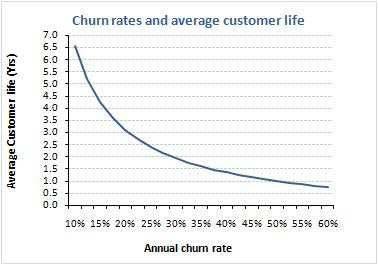
To reach a current market valuation of even $15bn for Groupon may require some aggressive, if not heroic assumptions will need to be made, including an act of faith on future underlying churn. Apply a 3 year valuation horizon and the group will need to be worth at least $20bn at the period end for it to justify $15bn today. Even if Groupon were to add another 20m customers over this period (from 16m currently to 36m) this would require an EV per customer at the period end of over $550. On an operational FCF yield range of 5%-7% (vs >12% for Google and 7% for the market for 2014e) I estimate that the underlying EBITA per customer would need to rise to $36-51 pa on this customer base (and after assuming a 30% normalised 30% tax rate and 100% cash conversion).

EBITA per customer needed to support Yr 3 EV of $20bn 

While no pretense at sophistication is being made in the above 'quick & dirty' calculations, they should help to provide a rough framework of some of the issues and assumptions that will need to be considered in formulating a valuation.  With Groupon still in 'land grab' mode, attention is understandably focused on the stellar growth being achieved in customers and revenues rather than the low barriers to entry and what may also prove to be modest scale advantages. With underlying growth already maturing in some of the earlier penetrated regions, growth is being increasingly based on the geographical extension of the brand, all of which require their own layer of  investment in areas such as sales to support them which might imply a higher level of variable costs and therefore lower rate of operational leverage in the business model than may be assumed in the IPO brouhaha. Using my earlier $15 per customer underlying EBITA estimate ($12-18 range) and 14x EBITA multiple (and 5% FCF yield) on a 36m customer base by 2014, this would suggest an EV of approx $7.5bn or an NPV of nearer $6bn. Not a million miles from Google's offer back in December which was rejected!

Land grab metrics
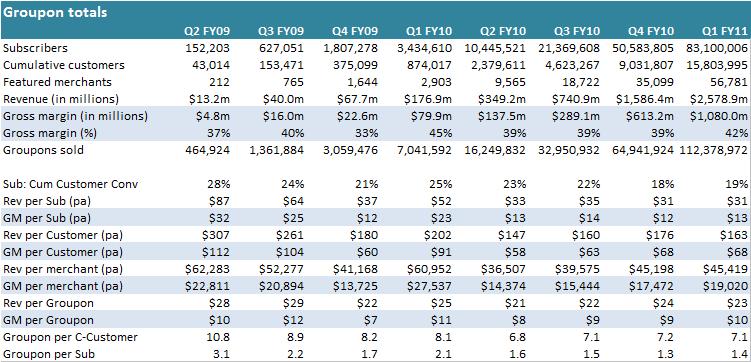
From a standing start to $2.5bn pa of revenues, 16m customers and a footprint across 500 markets in just 30 months is certainly impressive. In this dash for growth and first mover advantage however, it is easy to miss that the group has been increasingly reliant on the geographical extension of its model to drive this growth. In the process, the average conversion of 'subscribers' [those on the email distribution list agreeing to receive offers, rather than actual paying subscribers] to customers is in decline (42% in Q1 FY11 vs 45% in Q1 FY10). As Groupon only releases cumulative customer numbers rather than the more relevant active customers, this conversion ratio is therefore already flattered.  Revenue and more importantly gross margin per customer meanwhile are all broadly flat as are average Groupon and merchant margins.

Groupon - quarterly data (annualised)


Unit yield from legacy markets eroding
The original and early roll out regions however are beginning to mature. Absolute growth rates in subscribers, customers and Groupons are still being achieved, but the underlying yields on these are deteriorating. As the customer and merchant base ages, Groupon's yield is eroding. What is less clear is whether this is a natural maturing of the market as new entrants (both customers and merchants) dilute higher spending early adopters or a deterioration in the perceived value proposition by existing customers and merchants after using the service. 

Boston
QoQ revenue growth is still averaging approx +27%, but the quality of the underlying metrics are deteriorating. Revenues per subscriber are averaging -5% QoQ and -20% YoY,  revenues per customer averaging -7% QoQ and -26% YoY,  revenues per merchant averaging -1% QoQ and -23% YoY,  revenue  per Groupon  averaging -6% QoQ and -21% YoY and Groupons per customer averaging -2% QoQ and -7% YoY. 

For more on the Boston -
http://blog.yipit.com/2011/06/03/groupon-s-1-reveals-business-model-deteriorating-in-oldest-markets/


Chicago
As the longest standing Groupon region Chicago has exhibited similar trends as Boston with QoQ revenue growth is averaging approx +32%, but the quality of the underlying metrics also deteriorating. Revenues per subscriber are averaging -12% QoQ and -39% YoY, revenues per customer averaging -6% QoQ and -23% YoY, revenues per merchant averaging -7% QoQ and -35% YoY, revenue per Groupon averaging -1% QoQ and -5% YoY and Groupons per customer averaging -5% QoQ and -18% YoY.


Costs
Groupon is currently in a land-grab mode, while a valuation will try and anticipate what the  underlying costs will be in a more steady state environment. The rate of top-line growth has been phenomenal, but this has been more than matched by costs and without a clear perspective on churn, prospective investors may struggle to determine whether this has been acquired profitably from the GAAP numbers. Fully expensing SAC costs presents a fairly alarming increase in marketing costs per customer (from $12 in 2009 to $53 for Q1 FY11, annualised) and the rise in SG&A costs per customer also suggest a sizable step-up in fixed infrastructure spend to support the aggressive geographical expansion.   In total, GAAP operating costs per customer have trebled from $32 pa to $98 pa.


The challenge on modelling Groupon costs is twofold. What is the variable component to costs and over what period should these be recognised? In the below analysis I've guesstimated that variable costs have edged back from 67% to 63% of costs as some (25%) of the recent increase in marketing costs will have reflected a step-up in infrastructure costs from the extending the regional footprint. On the basis of the last reported results (Q1 FY11), amortising these variable costs over say 2 years (approx 30% customer churn) would therefore suggest an annualised variable costs at approx $31 per customer. Include fixed cost at around $36 and the total annual underlying costs would come in at approx $67 per customer vs the GAAP rate of $98.


Modelling gross margin and costs per customer by churn 


NPV per customer


NPV per customer
Applying a $70 per customer average cost (with a 63% variable component) and a 25% customer churn (2.5 Yrs av. life) should deliver an average FCF of approx $13 per customer pa (post tax at 30%). Assuming that the market reaches out beyond the current growth build out to a more steady state environment (in 2014), I estimate that the business could trade within a 5% to 7% operating FCF range (discounting CAGR of +7.5% and +5.5% respectively) and a per customer valuation of $191-$267.

Value per customer by churn and FCF yield


Groupon NPV estimate by customer growth and FCF yield


Appendix : Revenue metric charts

Revenue per subscriber: New regions clearly generate considerably less than the the legacy US ones of Chicago & Boston, although the gap is closing as these latter two erode.


Subscriber to customer conversion: New regions have brought down the average, although this metric is distorted by Groupon only reporting on cumulative, rather than active customer numbers which inevitably flatter the customer numbers for the longer established regions.

Revenue per customer: declines across all reported segments although again this will be in part diluted by reporting only cumulative customers rather than active ones

Groupons per customer: As above for revenues per customer


Revenue per Groupon : Apart from London and briefly Berlin, there is little variance by region; at least those disclosed. Trend however still downward, particularly for Boston & Chicago

Revenue per merchant: Relatively stable overall, but with considerable volatility by region and steep declines recently in Boston & Chicago